Summary
- 2026-09-22-pse-qa-akhil-patel-part-1 (2026-09-22): Patel downgrades the North Node in Aquarius as a timing tool: historically associated with US recessions, but the timing within the window varies (recession can land mid-window, as the node exits, or as it enters) — “not a precise timing tool.” PSE forecasts the stock market off the decade cycle, not the nodal cycle; and multi-year 2027/2028 forecast curves are directional only since they cannot absorb new information the way the annual roadmap does. — confidence: high [Source: PSE Q&A, Akhil Patel, 2026-09-22] Planetary cycles are a core (if understated) element of PSE’s and W.D. Gann’s timing methodology. Gann developed rules linking specific planetary formations and transits to market behavior in particular commodities and sectors. Phil Anderson and PSE contributors (especially Olga Morales and Gordon Brennan) use planetary timing as a secondary overlay to the 18.6-year land cycle. Key planets used: Saturn (30-year cycle), Jupiter (12-year cycle), Uranus (84-year cycle), North Node of the Moon (18.6-year cycle). The April 26, 2026 planetary formation matching Gann’s 1927 date is among the most specific PSE predictions.
Core Claims
- 2026-09-21-pse-sub-40-roadmap-update-september-2026 (2026-09-21): The Roadmap is described as a product of planetary interaction (“Your Roadmap is a result of planetary interaction” — Anderson’s standing framing), and this update operates it as such: the equinox (23 September 2026) is named as the immediate seasonal date to watch, with the market either reacting there or pushing down into it. Patel notes seasonal/equinox dates “almost invariably involve strong, reversal bars, volatile price action, or pauses in trend, or a swing, or emotional news or events” — the planetary-date mechanism stated as a behavioural claim. — confidence: high [Source: PSE Sub Email #40, 2026-09-21]
- 2026-03-18-bbi-march-2026 (2026-03-18): “April 26, 2026. The planetary formation that caused the Mississippi to flood…the spring rains could be late. That’s the same date that Gann had in 1927.” — Phil Anderson — confidence: high
- 2025-11-20-bbi-november-2025 (2025-11-20): “Extraordinary confluence: North Node Aquarius + K-wave peak + Saturn into Gemini + 18.6-year cycle all converging.” — confidence: high
- 2020-02-28-feb-2020-forecast-class-phil-session2-north-node (2020-02-28): McWhirter’s framework maps the North Node through zodiac signs to US business cycle highs and lows. — confidence: high
- 2020-01-25-sub-email-7-planetary-watch (2020-01-25): Gordon Brennan’s “Planetary Timing” presentation at London event described as unique and practically actionable. — confidence: high
- 2022-08-17-bbi-august-2022 (2022-08-17): Olga Morales’ planetary timing called the January 5 top, June 24 low, and August 19 high with high accuracy. — confidence: medium
- 2020-11-13-gann-sub-email-gann-03-13-november-2020-property-share-market-eco (2020-11-13): Saturn Return (~30-year cycle) underpins Gann’s publicly stated “important 30-year anniversary” — Gann avoided mentioning planetary timing publicly. — confidence: medium
- 2026-03-13-cotton-session-2013 (2026-03-13): Saturn/Neptune = drought, Jupiter/Neptune = good crops, Neptune/Uranus = floods; these rules govern cotton along the Mississippi. — confidence: medium
- 2026-07-01-pse-sub-28-roadmap-notes-into-july (2026-07-01): “Your Roadmap is a result of planetary interaction. This is what Gann put together in his analysis.” Anderson also shares AI-assisted Stonehenge reanalysis showing 56 Aubrey Holes encode the 18.6-year lunar nodal cycle (56 ≈ 3 × 18.6), connecting ancient cycle knowledge to PSE’s modern methodology. — confidence: high
Key Planetary Cycles in PSE Framework
Saturn (29.5-year orbit)
- Saturn in Pisces at “sensitive degrees” (24–28°): 1907 (Panic), 1937, 1966, 2025 — 75% hit rate for market downturns
- Saturn in Gemini (~every 30 years): Depressive effect on US business activity: 1853, 1883, 1913-14, 1942, 1972, 2001, ~2030
- Saturn-Jupiter conjunction: 20-year cycle; Phil references the December 2020 conjunction and the January 2026 Saturn-Jupiter-Neptune formation matching 1927
- April 26, 2026: Saturn-Jupiter-Neptune formation — same planetary geometry as April 26, 1927 (Gann’s Tunnel Through the Air reference; Mississippi flooding; market top signal)
Jupiter (11.9-year orbit)
- Jupiter in Gemini or Cancer: Lifts US business curve — 1953, 1965, 1977, 1989, 2001, 2013, 2024 (strong bull year)
- 1907 Panic: Jupiter in Gemini lifted → then panic when Jupiter moved; 100-year repeat = 2007
- Jupiter-Saturn cycle (20 years): Major economic rhythm; PSE uses conjunctions as timing anchors
Uranus (84-year orbit)
- Uranus in Gemini (~every 84 years, 7 years per sign): Every transit coincides with the US at war
- 1691–97, 1774–81 (Revolutionary War), 1858–66 (Civil War), 1941–42 (WWII), 2025–2032 (Iran war; ongoing)
- Also linked to page 82–84 of Gann’s Tunnel Through the Air (esoteric reference)
- America’s 250th anniversary (1776 + 250 = 2026): Anderson identifies the Uranus 84-year cycle as the timing mechanism that “helps explain the timing around America’s 250th anniversary.” Since 250 ≈ 3 × 84, the Uranus return cycle aligns with the quarter-millennial mark — connecting planetary timing to civilizational-scale political transitions. Anderson frames this as part of the convergence of “several major cycles” making the coming years “particularly significant.” [Source: PSE Sub #32, 2026-07-20]
North Node of the Moon (18.6-year cycle)
- The lunar nodal cycle is the astronomical basis for the 18.6-year real estate cycle
- North Node into Aquarius = US land price depression (see mcwhirter-cycles for full detail)
- North Node enters Aquarius in April 2026 — “never been an exception” per Phil Anderson
- This is the McWhirter framework’s central claim
Neptune (~165-year orbit)
- Neptune/Uranus = floods; Saturn/Neptune = drought (cotton rules per Gann)
- Neptune conjunction with Jupiter around 2026 region cited by Phil
Stonehenge as Ancient Cycle Instrument (2026 AI Reanalysis)
Anderson shared a 2026 AI-assisted reanalysis of Stonehenge (Grok/xAI processing all site measurements) that revealed the monument encodes the 18.6-year lunar nodal cycle — the same cycle underlying PSE’s real estate framework and McWhirter’s business cycle analysis. Key findings:
- 56 Aubrey Holes = 3 × 18.6: The hole spacing traces a sinusoidal pattern matching the lunar nodal cycle’s maximum/minimum declination swing. Dr. Jennifer Walsh (astronomer): “The correlation between Aubrey hole spacing and lunar orbital mechanics is statistically overwhelming. The probability of it happening by chance is effectively zero.” The ring functions as a “triple cycle calculator” tracking the moon across complete 18.6-year periods.
- Acoustic resonance: The sarsen circle produces standing waves at 95–120 Hz infrasound — frequencies associated with altered states of consciousness. Cremated remains cluster at acoustic “hot spots” (nodes of maximum infrasound intensity), suggesting deliberate placement.
- Landscape-scale geometric plan: The surrounding landscape (several km) was laid out as a single coordinated geometric design 500–1000 years before the sarsen circle was built, requiring surveying accuracy comparable to classical Greece, 2,500 years earlier than expected.
- Fading knowledge: The earliest stones are most acoustically precise (3.2 cm error); later stones drift (12.7 cm error). The builders were inheriting and slowly losing knowledge rather than inventing it — skill declines over time, the reverse of the expected civilizational progression.
- Deliberate shutdown ~1600 BCE: Stones placed with care, features covered with earth for preservation — “packing away something precious for future civilizations to rediscover.”
Anderson’s framing: Stonehenge demonstrates that cycle knowledge — specifically the 18.6-year lunar nodal cycle — is ancient, empirically grounded, and encoded in the most durable medium available. The Roadmap methodology extends this tradition: “Your Roadmap is a result of planetary interaction. This is what Gann put together in his analysis. But it’s like a jigsaw puzzle and I’ve found it’s often a bit more art than science sometimes.” [Source: PSE Sub #28, 2026-07-01]
This connects directly to McWhirter Cycles (the lunar nodal cycle as astronomical basis for the 18.6-year real estate cycle) and 18.6-Year Real Estate Cycle (PSE’s core framework). The Stonehenge evidence suggests the 18.6-year cycle was known and formally encoded at least 5,000 years ago — long before Gann, McWhirter, or Hoyt.
Gann’s Approach to Planetary Timing
Gann was known to:
- Hand-draw daily/weekly/monthly/quarterly charts for every NYSE stock for 50 years
- Include planetary/astrological overlays on these charts
- Deliberately avoid public mention of planetary timing to avoid scrutiny (“just a very important 30-year anniversary”)
- Encode planetary information in fiction (Tunnel Through the Air, 1927)
Evidence that Gann used astrology comes from Jon Kirk’s access to Gann’s original hand-drawn chart archive (owned by Nikki Jones), which shows astro overlays. Phil Anderson and Kirk both cite this as evidence that Gann’s published “mathematical” methods were often planetary cycles in disguise.
Olga Morales
An Australian expert on planetary market timing, introduced by Phil Anderson at the BBI August 2022 session. Her calls in 2022:
- January 5 top: confirmed
- June 24 low: confirmed
- August 19 high: confirmed Phil described her work as providing high-precision short-term timing overlaid on the longer cycle structure.
Cotton and the Mississippi (Gann’s Commodity Rules)
From Phil’s 2013 Melbourne class (referenced in 2026):
- Saturn/Neptune conjunction: Drought along the Mississippi → poor cotton crop → high prices
- Jupiter/Neptune conjunction: Good crops → low price at harvest
- Neptune/Uranus conjunction: Floods → crop disruption Phil has stated since 2013 that 2026 would see Mississippi flooding, tied to the April 26 planetary formation. Spring 2027 is also flagged.
Applications
- Use Saturn ingress into Gemini (~2030) as a signal for economic depression risk
- Watch April 26, 2026 as a potential market turning point
- Jupiter in Gemini/Cancer years tend to be bullish — track as secondary signal
- Uranus in Gemini (2025–2032): expect ongoing US military engagement
- North Node into Aquarius (April 2026): stock market decline signal per McWhirter
Contradictions & Open Questions
- PSE officially presents planetary timing as secondary/suggestive, not deterministic
- The 75% hit rate for Saturn in Pisces = 1 failure in 4, which means it’s not reliable alone
- Gann’s planetary methods are not fully documented publicly — much is inferred
- Critics would characterize this as confirmation bias / post-hoc rationalization
- The April 26, 2026 date is specific enough to falsify: if no major market event occurs, the planetary formation claim is weakened
Related Concepts
Visual Evidence
Slides showing astrological/planetary cycle analysis as applied in PSE and Gann frameworks.
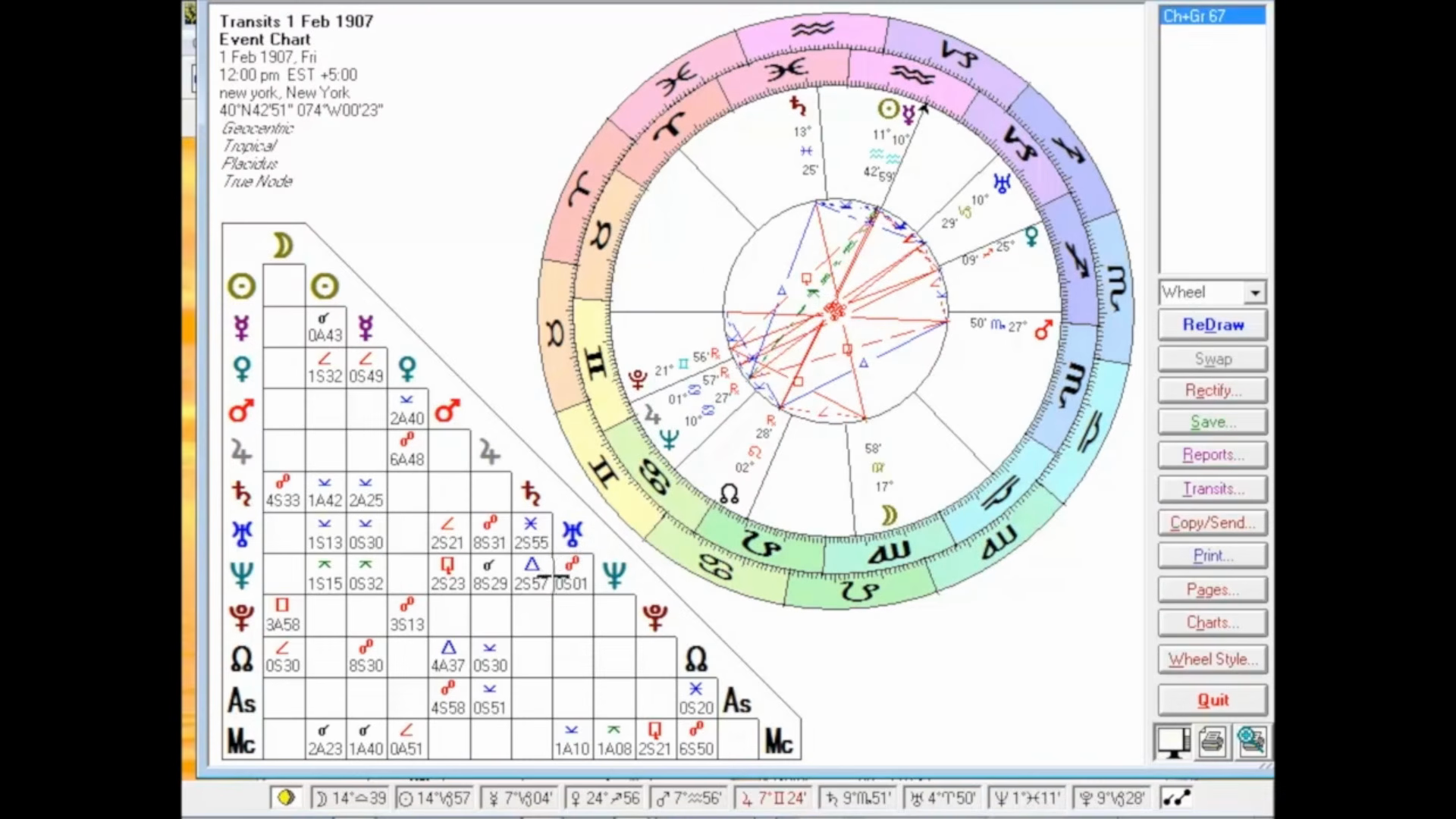 Planetary chart — astrological alignment used for market timing analysis.
Source: PSE Video
Planetary chart — astrological alignment used for market timing analysis.
Source: PSE Video
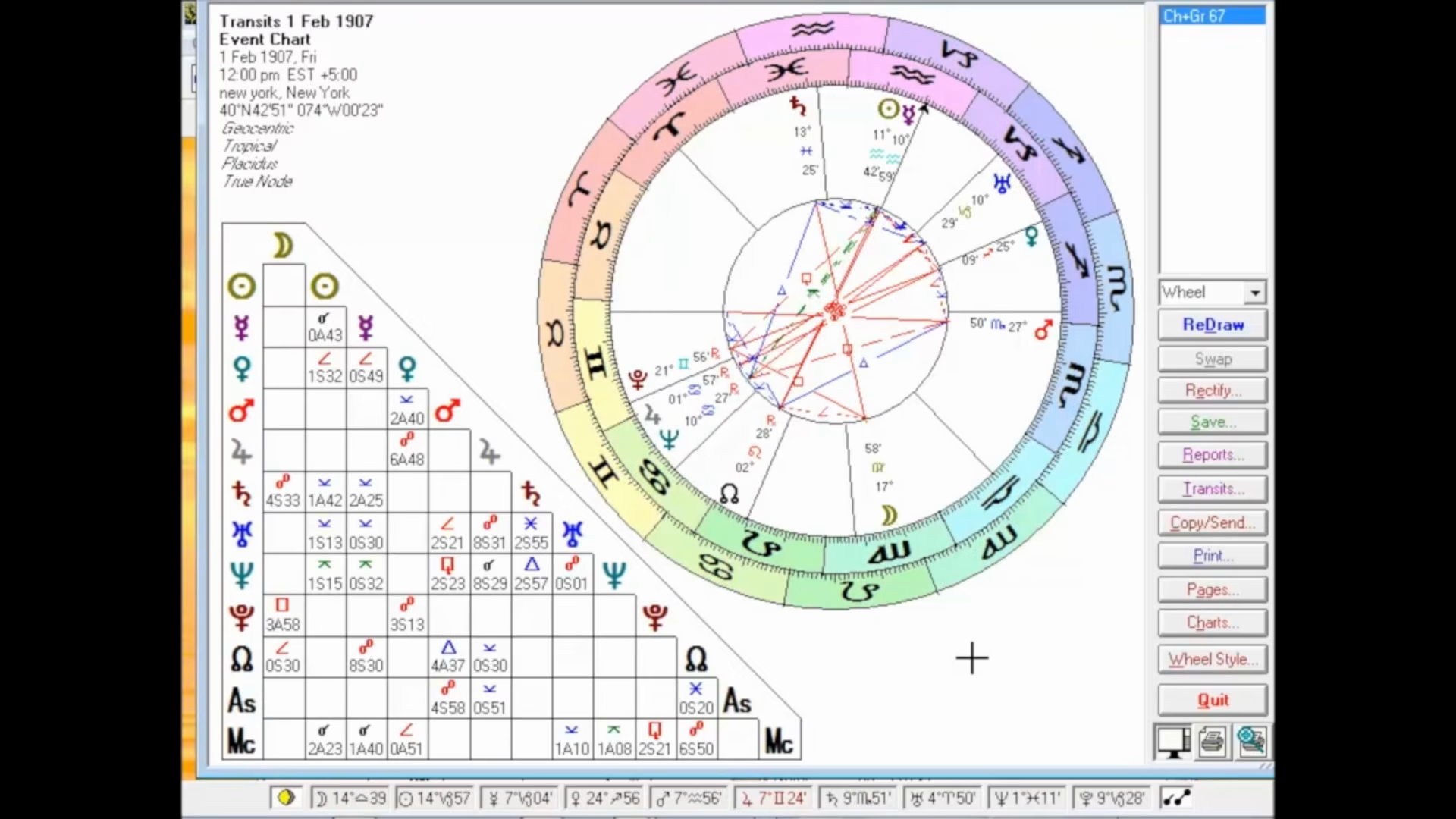 Celestial wheel — diagram illustrating planetary cycle relationships.
Source: PSE Video
Celestial wheel — diagram illustrating planetary cycle relationships.
Source: PSE Video
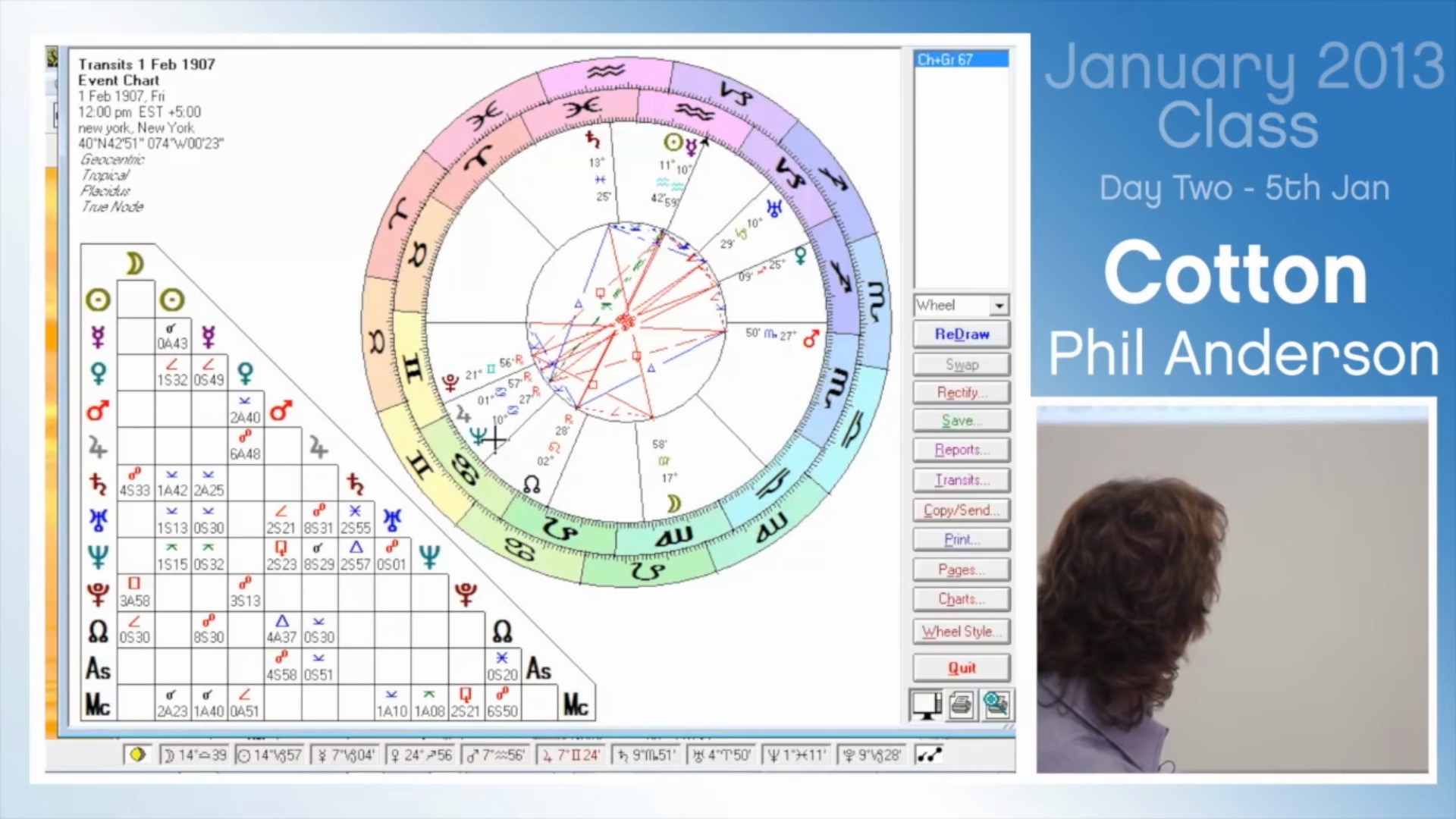 Astrology chart — planetary chart applied to commodity (cotton) market analysis.
Source: PSE Video
Astrology chart — planetary chart applied to commodity (cotton) market analysis.
Source: PSE Video
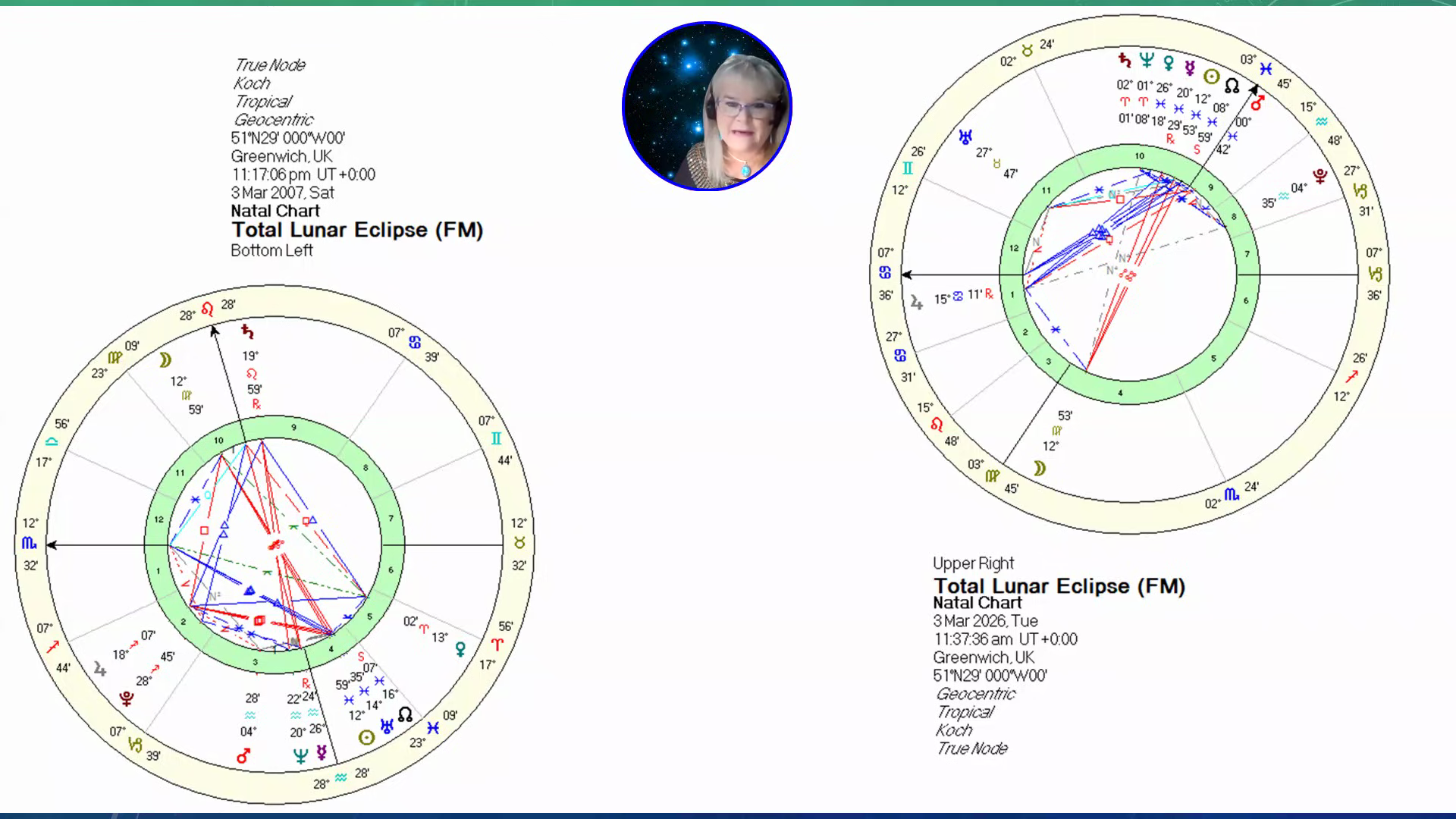 Astrological charts — multiple planetary cycle charts with market commentary.
Source: PSE Video
Astrological charts — multiple planetary cycle charts with market commentary.
Source: PSE Video
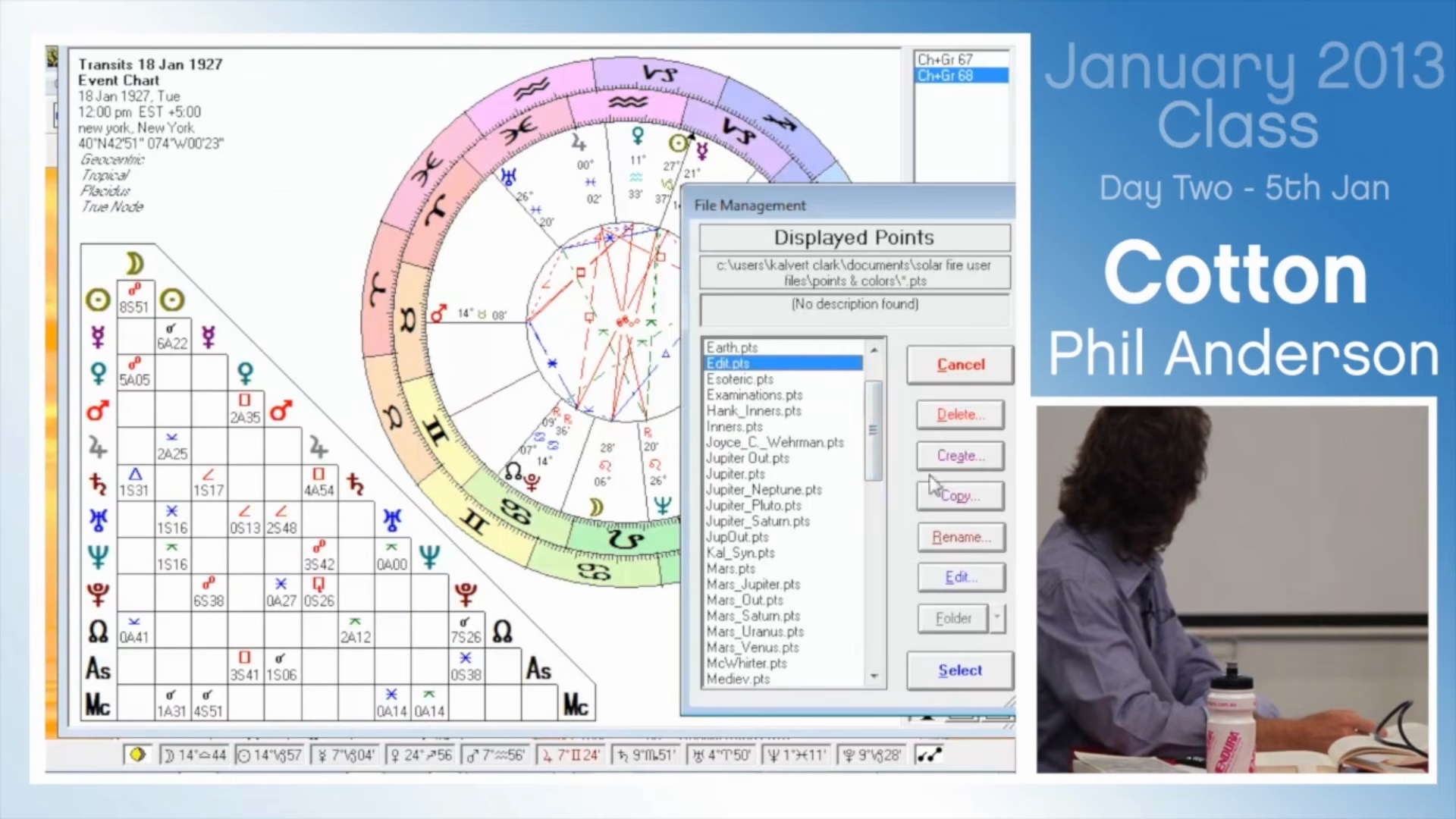 Astrology software interface — chart analysis software used in PSE/Gann research.
Source: PSE Video
Astrology software interface — chart analysis software used in PSE/Gann research.
Source: PSE Video
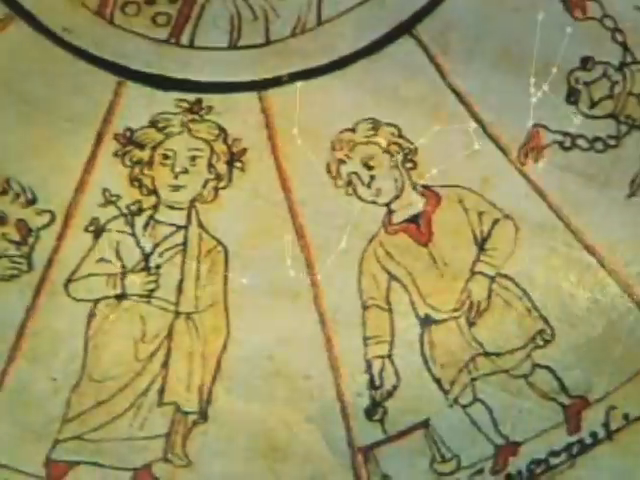 Zodiac wheel — Sun and planetary positions as cycle reference points.
Source: PSE Video
Zodiac wheel — Sun and planetary positions as cycle reference points.
Source: PSE Video
 Zodiac signs and solar cycles — how the zodiac maps to market turning points.
Source: PSE Video
Zodiac signs and solar cycles — how the zodiac maps to market turning points.
Source: PSE Video
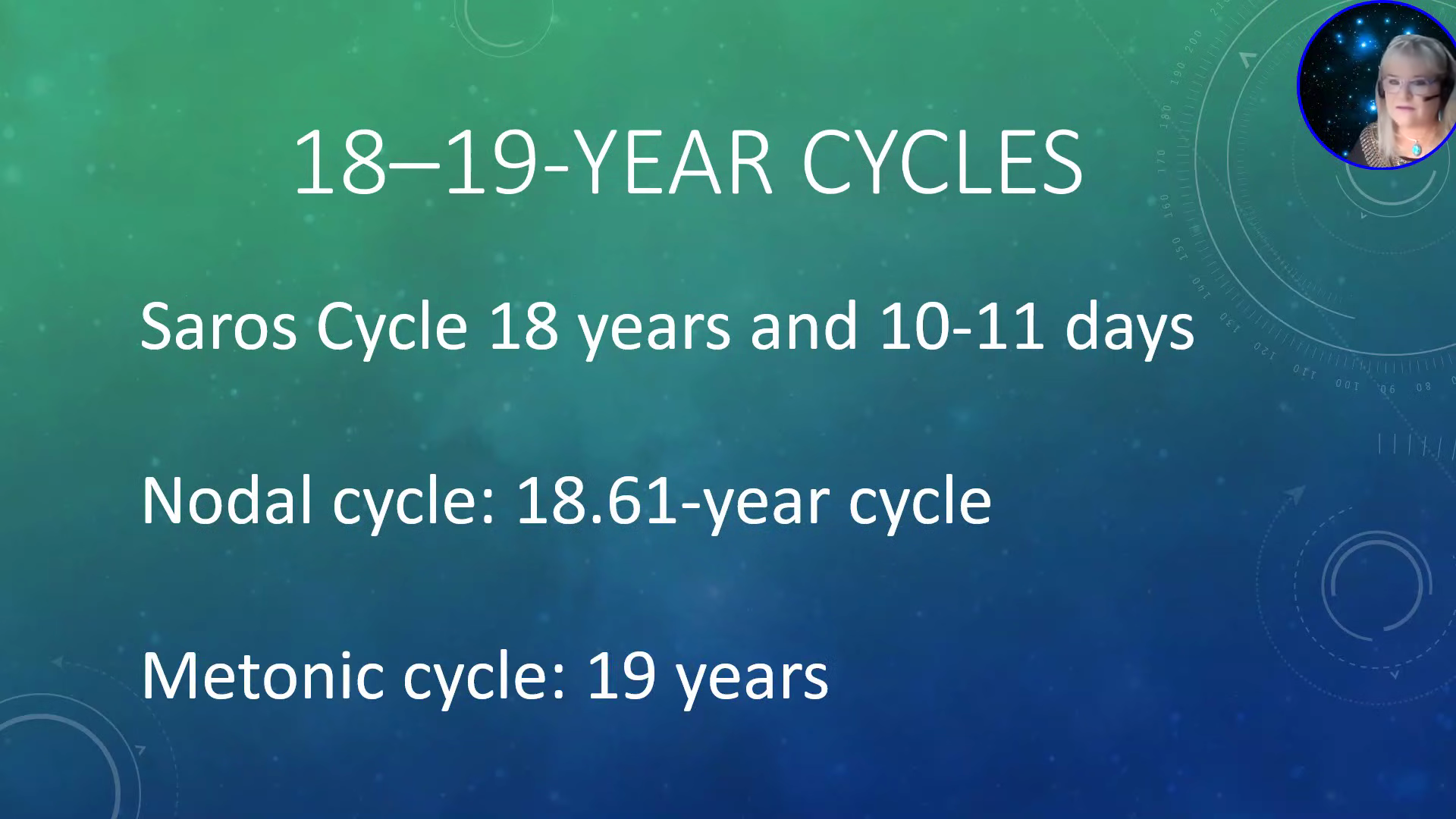 Lunar eclipse natal charts — eclipse timing used as market signal reference.
Source: PSE Video
Lunar eclipse natal charts — eclipse timing used as market signal reference.
Source: PSE Video