Summary
W.D. Gann developed a system of time counts - specific calendar dates derived from planetary positions, seasonal turning points, and degree-based counting - that identify when markets are likely to change trend. PSE, led by Phil Anderson, applies “Gann dates” (monthly pressure points), seasonal dates (solstices/equinoxes and their midpoints), and degree-counting (30°, 60°, 90°, 150°, 240° counts from key market highs/lows). Gann’s original framework was developed in the early 20th century independently of the 18.6-year land cycle tradition; PSE synthesizes both. The system also applies to individual lives - tracking emotional peaks in famous people’s biographies.
Core Claims
- 2026-01-09-gann-dates-2026 (2026-01-09): Gann’s 1929 forecast (November 1928) correctly predicted March low, August/September high, and that leading stocks would top first. - confidence: high
- 2026-01-09-gann-dates-2026 (2026-01-09): Gann used 20-year (1909) and 60-year (1869) repeats to construct the 1929 forecast. - confidence: high
- 2026-01-09-gann-dates-2026 (2026-01-09): 2026 seasonal dates: March 21, June 22, September 23, December 22; mid-points February 2/3, May 4, August 6, November 6. - confidence: high
- 2026-01-14-small-cycles-large-cycles (2026-01-14): Iranian hostages held exactly 420 days (60 weeks) - Gann time count applied to geopolitical events. - confidence: high
- 2026-03-26-notes-and-items (2026-03-26): March 27 = 150° from Oct 29 2025 top, 60° from 2026 top, 30° from Feb 28 war start. - confidence: high
- 2026-03-26-notes-and-items (2026-03-26): Feb 28 (Iran war start) is 240° in days from US mid-terms, split by July 4. - confidence: high
- 2026-01-19-eclipse-seasonal-reminders (2026-01-19): Feb 17 solar eclipse → count 30, 60, 90 days; especially 60 days = April. - confidence: high
- pse-sub-email-gann-06-for-2026-7-roadmap-current-market-16-april-2026 (2026-04-16): Late April is 30 months from Oct 2023 low, and 180 days from Oct 2023 Nasdaq 100/AI stock peak. - confidence: high
- 2026-04-28-pse-market-update-gann-08 (2026-04-28): May 4 is a seasonal midpoint date between the spring equinox (Mar 21) and summer solstice (Jun 22); Phil Anderson flags this as a key Gann date aligned with the Roadmap’s change-in-trend signal. - confidence: high [Source: PSE Gann #08, 2026-04-28]
- BBI Q&A April 29 2026 (2026-04-29): Phil Anderson confirms the 30-month count from October 2023 low → April 2026 as a key inflection; projects the next 30 months (2½ years) pointing to October 2028 for the full unwind. PSE identifies NASDAQ recent top as 4,320 trading days from the March 2009 low (Gann square/count). Also noted: 7,200 calendar days from Gold’s May 2006 top = January 2026 top (72 × 100); and 64-week sideways gold pattern (64 = 8²). — confidence: high [Source: BBI April 29 2026, 2026-04-29]
- 2026-05-18-pse-sub-email-gann-11-set-up-examples (2026-05-18): Mining stocks specifically tend to see changes of trend around the 12th and 28/29 of some months, in addition to the standard monthly Gann dates (4th, 15th, 21/22). Solstice and equinox dates remain useful for all stocks. — confidence: high [Source: PSE Gann #11, 2026-05-18]
- 2026-06-25-bbi-june-2026-qa (2026-06-25): October 26, 2026 is a key convergence date where multiple GANN time counts arrive simultaneously: 144 days from June 2026 high, 270 days from January 2026 high, 210 days from March 2026 low, 81 weeks (9 squared) from April 7 2025 panic. Additionally, 153 days from June high → November 3 (biblical number). Also: 420 days from April 7 2025 low gave the June 2026 recent top. — Cathy Stacey — confidence: high [Source: BBI Q&A June 2026, 2026-06-25]
- 2026-07-01-pse-sub-28-roadmap-notes-into-july (2026-07-01): “Time turns the trend, not price.” Anderson quotes this as a core Gann principle after observing June’s sharp one-day price reversals: “June saw a number of quick, sharp reversals in price, in a very short period of time. Like a day only. This is bullish for markets. (Usually significantly bullish.) Gann pointed that out. It’s counterintuitive, I know. But it’s correct.” — confidence: high [Source: PSE Sub #28, 2026-07-01]
- 2026-07-20-pse-sub-32-from-the-vault (2026-07-20): Gann’s explicit forecast: “Another bad period for the United States will be 2026 to 2030.” Anderson surfaces this quote while directing subscribers to the February 2020 Forecast Class for Gann’s time-cycle and North Node framework, emphasising that the material remains relevant because the cycles are still unfolding. — confidence: high [Source: PSE Sub #32, 2026-07-20]
- 2026-07-30-bbb-postcard-41-berkshire-taylor-morrison (2026-07-30): Darren Wilson maps Toll Brothers’ triple top pattern (three failed attempts to break November 2024 highs) directly to Gann’s 1941 soybean campaign from the 90/41 soybean class — where Gann began a year-long bull campaign after a triple bottom. Wilson sees the inverse: a potential 12–15 month short campaign on Toll Brothers. This is a practical application of Gann’s repeated-failure-at-a-level methodology to individual stock setups. — confidence: high [Source: BBB Postcard #41, 2026-07-30]
- [[sources/2026-04-08-pse-sub-23-current-update|PSE Sub #23]] (2026-04-08): Critical Gann time counts converging at end of March 2026: 30 weeks from Aug 7 bond market pressure, 30 months from October 2023, 72 months (6 years) from March 2020 COVID lows, 90 years from Hitler’s Rheinland reoccupation. All converge at end of March → hallmarks of a yearly low. Also: “never short the second higher low” — Gann trading rule. NYC securities industry bonus pool as a cycle indicator suggesting “one more year to go.” — confidence: high [Source: PSE Sub #23, 2026-04-08]
- [[sources/2026-05-07-pse-sub-24-information-catch-up|PSE Sub #24]] (2026-05-07): April extreme volatility = 30 weeks from US midterms. May 1 high into May 4 seasonal midpoint = 180 degrees from US midterms. Indicates volatility and trend change into first week of November. — confidence: high [Source: PSE Sub #24, 2026-05-07]
Mechanism / How It Works
- Seasonal dates: equinoxes and solstices (and their midpoints) are the year’s primary turning-point windows ±1-2 days
- Monthly “Gann dates”: planetary-angle pressure days each month - transport delays, personal decisions forced, market direction changes. Primary monthly dates: approximately the 4th, 15th, and 21/22 of each month. Solstice and equinox dates remain the most significant across all instruments.
- Mining stock date refinement: Mining stocks (ASX and US-listed resource companies) specifically tend to see changes of trend around the 12th and 28/29 of some months, in addition to the standard monthly Gann dates. Anderson flagged this as a sector-specific pattern in Gann #11 (May 2026). [Source: PSE Gann #11, 2026-05-18]
- Degree counting: count forward in degrees (treating 1 day = 1 degree): 30°, 60°, 90°, 120°, 150°, 180°, 240°, 270°, 360° from key highs/lows
- Year repeat cycles: 20-year, 60-year, 90-year repeats used to forecast year shape (e.g., 2026 ≈ 2006 and 1966 patterns)
- Personal cycles: 30-year, 45-year, 60-year counts applied to key people’s life events (marriage, power, death)
- Time over price: Gann’s principle that “time turns the trend, not price” — meaning that trend changes are driven by time cycles (seasonal dates, degree counts, planetary angles) rather than price levels. Sharp one-day price reversals are a bullish signal under this framework, as they indicate time-based trend changes without sustained price damage. Anderson (Sub #28, 2026-07-01): “Gann pointed that out. It’s counterintuitive, I know. But it’s correct.” [Source: PSE Sub #28, 2026-07-01]
Key Evidence
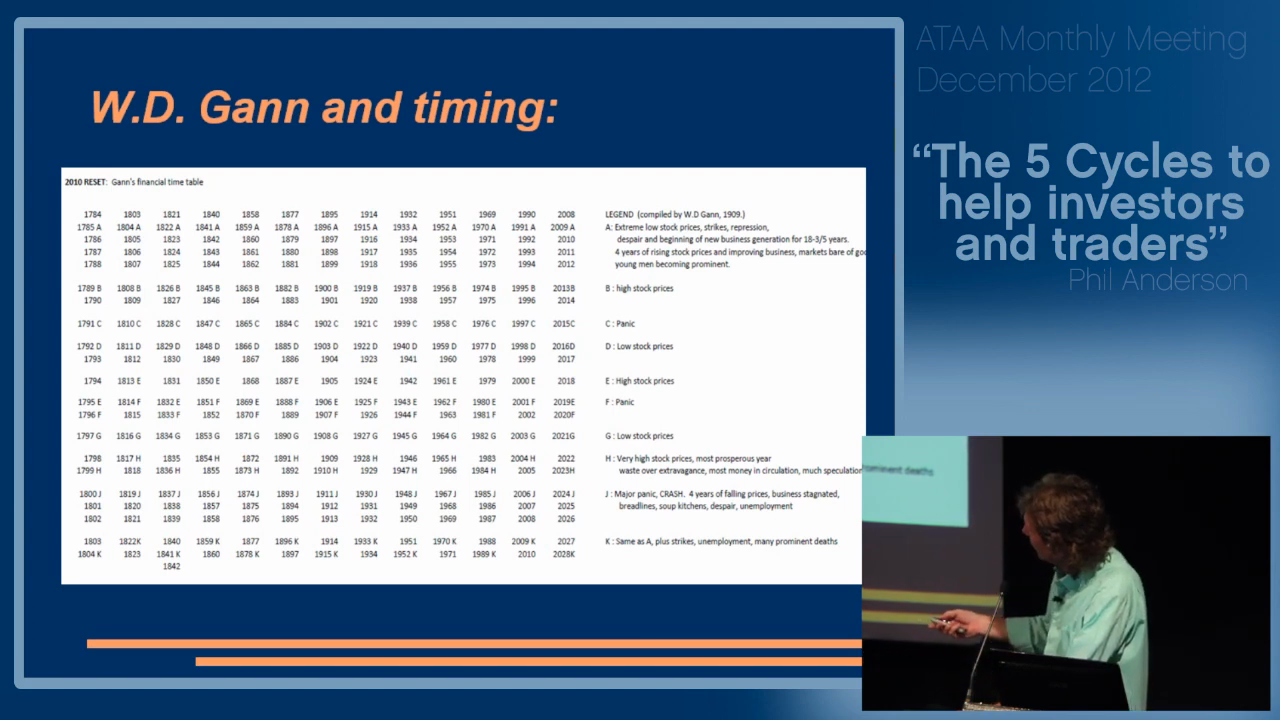 Gann Financial Timetable - chart with years and seasonal turning-point markers.
Source: PSE Video
Gann Financial Timetable - chart with years and seasonal turning-point markers.
Source: PSE Video
WD Gann’s cyclical framework - informational slide on Gann’s timing methodology.
Source: PSE Video
- Saturn at 24-28° Pisces (April 2025): predicted in 2025 email #8, produced volatility exactly as forecast
- Feb 17, 2026 solar eclipse at 28° Aquarius with Saturn/Neptune at 0° Aries - key timing marker for April
- Gann’s 1929 forecast: 4+ years in advance predicted October 3, 1931 bear market low in Tunnel Thru the Air (1927)
- Great Chicago fire October 8-10, 1871; Gann gold panic September 23-24, 1869 - cycle confirmation data points
Applications
- Put Gann dates in phone/calendar; observe headlines ±12 hours; do opposite of emotional headline
- “On these days, transport is more likely to run late, city traffic heavier, decisions forced”
- Count 30/60/90 days from key market turns and news events
- Watch PSE seasonal dates for primary trend changes
Evolution Over Time
- Gann dates evolved from PSE research applied over many years of observation
- Saturn/Neptune/Jupiter planetary rules for commodity markets (cotton, etc.) are a separate sub-application
- Phil Anderson integrates personal cycle counting into Gann Class content
- June 2026: Late-June solstice (Jun 22) flagged as an actionable weakness window per PSE forecast curves. Anderson notes this as aligned with another period of weakness, making short setups on stocks bouncing weakly off key support levels the current focus. [Source: PSE Gann #16, 2026-06-09]
- June 16, 2026 (Gann #17): Anderson confirms: “Most curves are aligned with a near-term peak in late June and a pullback into July.” The June 22 solstice is identified as the key Gann date for this window. Separately, the US Dollar Index is flagged for a potential seasonal direction change — testing $100 resistance for the sixth time in the past year as it approaches the seasonal date. The USD seasonal pattern (direction changes around key seasonal dates) is a recurring Gann-time application to currency markets. [Source: PSE Gann #17, 2026-06-16]
- June 22, 2026 (Gann #18): The solstice arrives this week as the flagged seasonal date. Anderson notes DXY has broken above the 100 level — the high end of a range going back a year — and reiterates that “DXY will often see trend reversals on seasonal dates and their midpoints.” A reversal of the move above 100 would set up IEFA (international equity ETF) as a Mexican Pete beneficiary of a weakening dollar. The solstice is also the window Anderson had previously flagged (Gann #16, #17) for late-June weakness and a pullback into July. [Source: PSE Gann #18, 2026-06-22]
- June 25, 2026 (BBI Q&A): Cathy Stacey identifies October 26, 2026 as a critical convergence date where multiple independent time counts arrive simultaneously: 144 days from June high, 270 days from January high, 210 days from March low, 81 weeks (9²) from April 7 2025 panic. She will be watching this date for volatility leading into the November 3 US midterms. Additional counts: 153 days from June high → November 3 (biblical number); 420 days from April 7 2025 low → June 2026 top (confirmed). The July 7 Aphelion (earth furthest from Sun, moon’s third quarter, 120 days back from midterms) is also flagged. Stacey presented SPX midterm history charts back to 1986 showing that 2018 was the only midterm with a meaningful pre-election downtrend. [Source: BBI Q&A June 2026, 2026-06-25]
- July 8, 2026 (Gann #21): Anderson demonstrates the seasonal-date mechanism in action across asset classes. The DXY rallied into the June 22 solstice following a trend change around the May 4 midpoint date, then reversed lower — confirming that seasonal dates and their midpoints produce direction changes in currency markets. Simultaneously, the 30-year Treasury yield reversed higher on the seasonal date after pulling back from a false breakout above 5%. Anderson: “Seasonal dates and their midpoints are important Gann dates to watch throughout the year, especially when markets are in the midst of a strong trend.” The dollar and long rates show why seasonal Gann dates extend beyond the stock market. [Source: PSE Gann #21, 2026-07-08]
- September 10, 2026 (BBI Q&A): Stacey presents updated DJI daily-chart time counts projecting into the week before the November 3 midterms and the week of — potential reversals or midpoints: “worth being alert around those dates.” She also adds Brent crude counts from the week of October 26 (the same week as the June Q&A’s four-count convergence) and the midterm week, counted from a long line back to the March 2022 high — 56 months, where 56 × 3 = 168 and 56 / 3 ≈ 18.6, explicitly resolving the commodity count to the 18.6-year cycle number. Equity and energy time counts now converge on the same late-October/midterm window. [Source: BBI Q&A September 2026, 2026-09-10]
- September 21, 2026 (Sub Email #40 — Akhil Patel, Roadmap update): The 5 August 2026 Dow high sits approximately 90 degrees off the 3 November US mid-term elections; early May is the 180-degree counterpoint and ~30 weeks prior (early April) carried the Iran serviceman rescue and Trump’s 48-hour Strait of Hormuz ultimatum. Patel reads the cluster as the market signalling turbulence/emotion into early November — a node he expects to resolve upward into year-end per the Roadmap, while stressing the discipline clause: “you invest or trade according to the trend, not the forecast.” He also demonstrates the midpoint-vs-turn behaviour of seasonal dates: the early May mid-seasonal date produced no high but marked the price-and-time midpoint of the March→August advance; the 23 June solstice did the same over a smaller range. The immediate dated test is the equinox (23 September). [Source: PSE Sub Email #40, 2026-09-21]
Contradictions & Open Questions
- Planetary/esoteric basis is not provable via conventional finance theory - requires empirical observation
- Phil notes: “if the day falls on a weekend… not always” - some imprecision acknowledged
- How Gann’s original system (early 20th century equity markets) translates to 21st-century global markets is not fully documented
Related Concepts
August 2026 Update — “Using Time”: The Chipmaker Selloff as a Live Count Study (Gann #25)
Phil Anderson’s Gann #25 for 2026-27 (Aug 4, 2026) is a worked example of Gann’s ‘time’ method on the July 2026 semiconductor bear market (key gauge -20% from record, worst week since the April 2025 trade-war rollout):
- July 2026 = 15 months (half of 30) from the April 2025 low. Confluence at the late-July panic lows: 150 days from the start of Iran proceedings, 120 days from the March low, 180 days from the prior high, 270 days from last year’s high, NASDAQ just above 50% of the prior year’s range → “do the opposite to the headlines. Price into Time.” Another US stock market low likely in place for the year; higher lows = trend up; Roadmap red line intact. [Source: [[sources/2026-08-04-gann-25-using-time|PSE Gann #25]], 2026-08-04]
- Revolutionary-cycle count: Gann’s Tunnel Thru the Air pp. 82–84 (“Another bad period for the United States will be 1940 to 1944”) extended 82–84 years → “2026 to 2030” (Uranus in Gemini; 1780s → 1860s → 1941+). [Source: [[sources/2026-08-04-gann-25-using-time|PSE Gann #25]], 2026-08-04]
- Pancholi anniversaries: 36 years (half of 72) from Iraq entering Kuwait → January 2027 repeat; Aden/South Yemen mid-1960s repeats 2027. [Source: [[sources/2026-08-04-gann-25-using-time|PSE Gann #25]], 2026-08-04]
More Charts
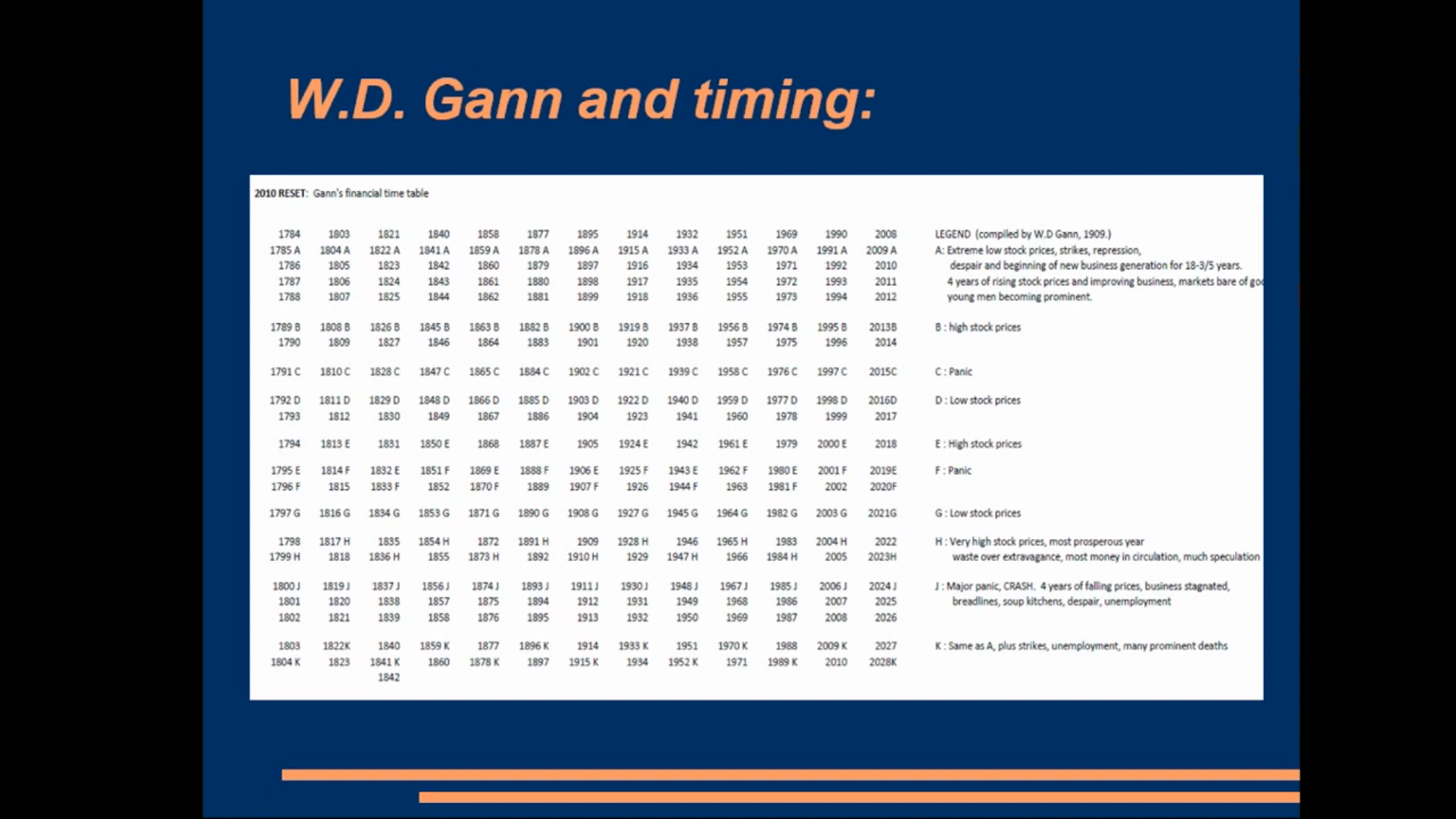 Table of Gann’s Financial Time - correlating cycle dates with market events.
Source: PSE Video
Table of Gann’s Financial Time - correlating cycle dates with market events.
Source: PSE Video
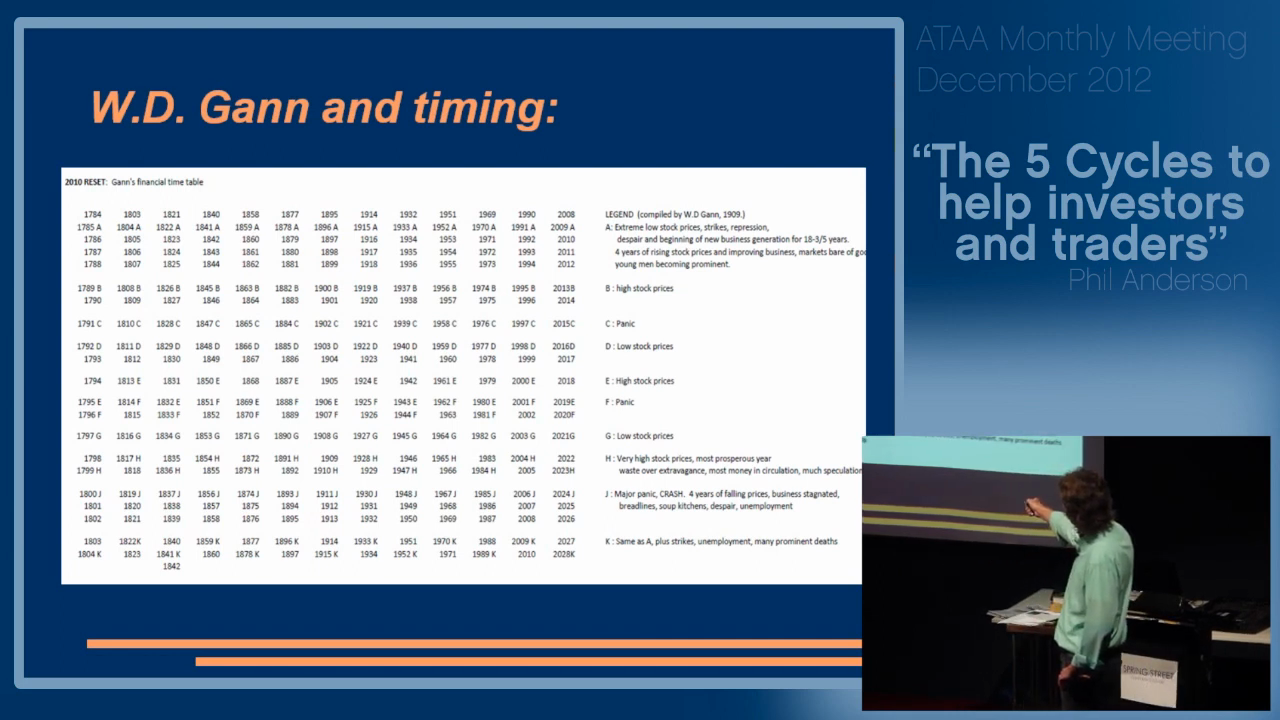 WD Gann’s financial insights - slide detailing Gann’s analytical framework.
Source: PSE Video
WD Gann’s financial insights - slide detailing Gann’s analytical framework.
Source: PSE Video
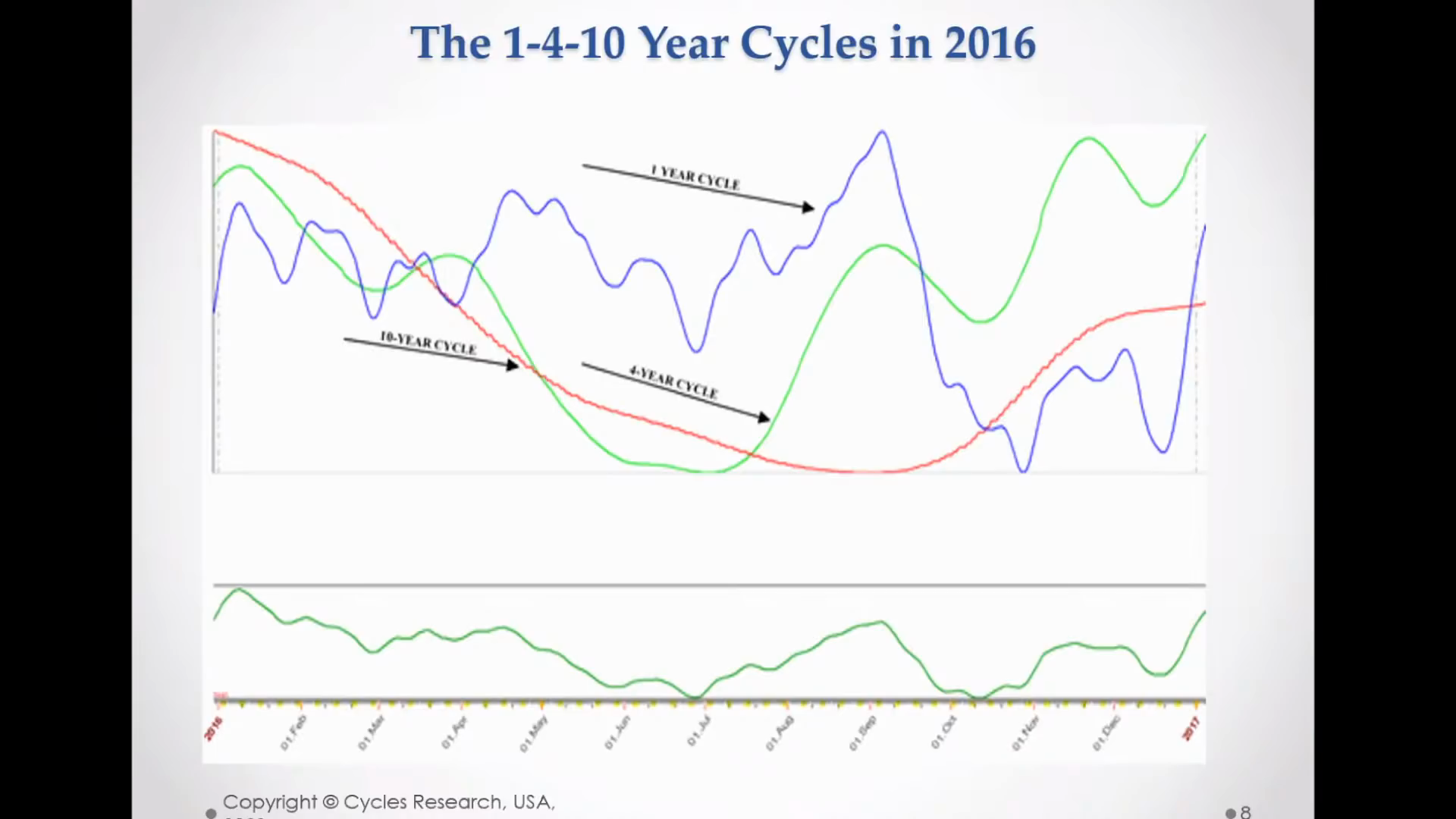 1, 4, and 10-year cycles - short and medium cycle overlays used in timing analysis.
Source: PSE Video
1, 4, and 10-year cycles - short and medium cycle overlays used in timing analysis.
Source: PSE Video
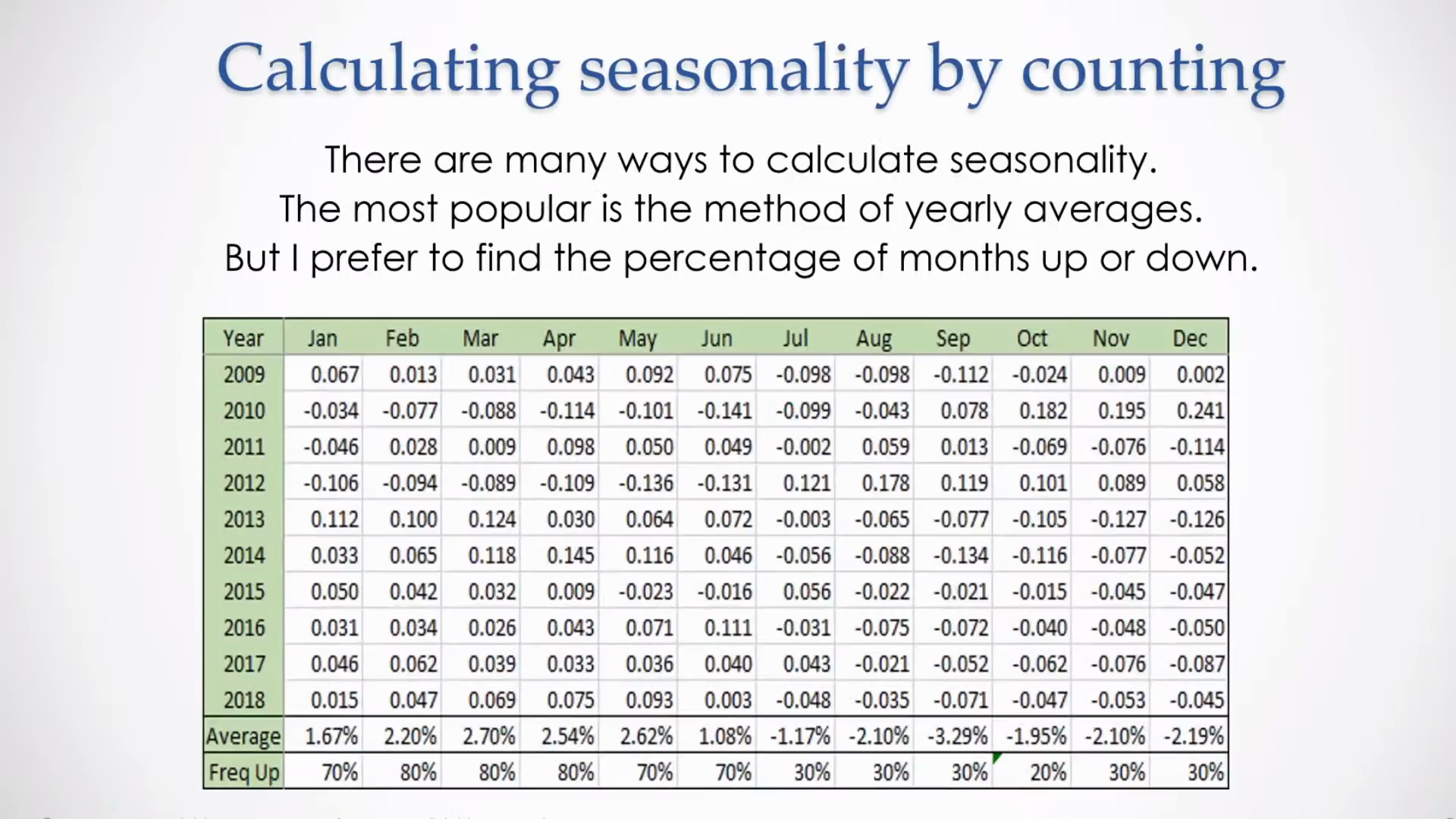 Seasonal patterns - PSE’s seasonal dates framework (solstices, equinoxes, midpoints).
Source: PSE Video
Seasonal patterns - PSE’s seasonal dates framework (solstices, equinoxes, midpoints).
Source: PSE Video
 Seasonality and cycles - how seasonal turning points interact with larger cycles.
Source: PSE Video
Seasonality and cycles - how seasonal turning points interact with larger cycles.
Source: PSE Video
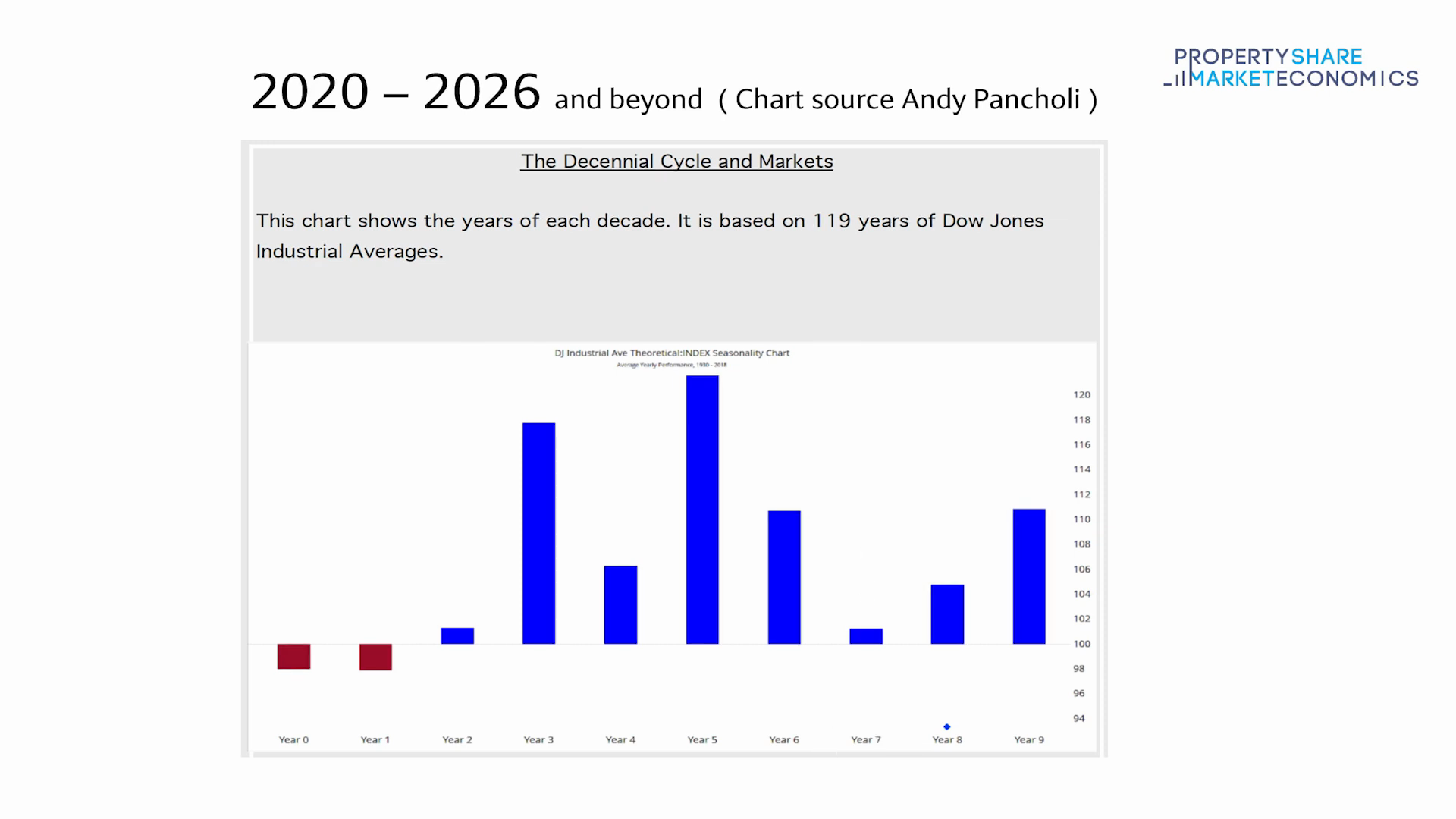 Decennial cycle chart - Dow Jones 10-year repeating pattern used for timing.
Source: 2022-10-01-bbi-gold-coast-session-part-2
Decennial cycle chart - Dow Jones 10-year repeating pattern used for timing.
Source: 2022-10-01-bbi-gold-coast-session-part-2
- [[sources/2026-04-07-gann-04-time-counts-trading-opportunities|Gann #04]] (2026-04-07): In years ending in “6”, equinox/solstice dates are less pronounced — the midpoints between them tend to matter more. The 150/60/30-day count sequence from prior turns pointed into March 27–31, 2026 — and the market bounced exactly as forecast. Newspaper headline test: if the FT front page headline is negative but NOT about the stock market, the equinox midpoint setup favours a contrarian bounce. — confidence: high [Source: PSE Gann #04, 2026-04-07]
- [[sources/2026-04-09-gann-05-market-and-portfolio-update-9-april|Gann #05]] (2026-04-09): 120 weeks from the October 2023 low = mid-February 2026 Dow peak. 30 months from that same low = late April 2026. Triple convergence with the 2026 Roadmap 20/60 curve and the May 4 seasonal midpoint. — confidence: high [Source: PSE Gann #05, 2026-04-09]
Additional Sources
- 2026-07-29-bbb-postcard-42-trump-economic-hit-men-redundant (2026-07-29): Phil Anderson uses Gann’s principle that “history repeats in set time frames” to draw structural parallels between Nazi Germany’s enablers and the current US presidency. References Gann’s methodology as the framework for identifying historical pattern repetition. [Source: PSE, BBB Postcard 42, 2026-07-29]
- 2026-08-20-bbi-august-2026-qa (2026-08-20): Cathy Stacey applies Gann time counts to Japanese 30-year bond yields: July 2026 = 120 months from July 2016 extreme low; September 2026 = 84 months from September 2019 higher low. Whether these time counts invoke a reaction is being watched. Extends Gann’s time-count methodology from equities/commodities to sovereign bond markets. [Source: BBI August 2026 Q&A, 2026-08-20]
- [[sources/2026-09-23-gann-33-seasonal-timings|Gann #33]] (2026-09-23): Equinox seasonal date (23 September) applied to three instruments at once — the US Dollar Index rallying into the date (seasonal dates and their midpoints often mark dollar reversals), GDX retracing to its 200-day moving average with the 50-day near a bullish cross, and RSP diverging negatively from the cap-weighted S&P 500. Time counts cited on GDX: the most recent high was 30 days ago, the late-July low 60 days ago — “a good example of how you can combine the elements of time and seasonal dates with technical analysis.” — confidence: medium [Source: PSE Gann #33, 2026-09-23]