Summary
PSE frames US foreign policy — including Venezuela, Iran, Libya, Iraq, Syria, Cuba — as driven primarily by the need to preserve the petrodollar system. Countries that attempt to sell oil in non-dollar currencies are targeted for destabilization or regime change. This is described as a form of “rent extraction” at the geopolitical level — capturing the rent of natural resources and financial intermediation globally. BRICS’ “The Unit” payment system is the primary existential threat.
Core Claims
- 2026-01-12-us-dollar-venezuela (2026-01-12): “The US economy would collapse if this broke suddenly” — referring to petrodollar system. — confidence: high
- 2026-01-12-us-dollar-venezuela (2026-01-12): BRICS started “The Unit” transaction payment system for oil trade among members. — confidence: high
- 2026-03-31-roadmap-update-march (2026-03-31): “The United States simply cannot allow this exorbitant privilege to end. It is the one thing that enables it to live far beyond its means.” — confidence: high
- 2026-03-31-roadmap-update-march (2026-03-31): Venezuela, Iran, Libya, Iraq, Syria, Cuba all targeted for moving toward non-dollar oil sales. — confidence: high
- 2026-03-27-holy-war-holy-benefits (2026-03-27): Venezuela coup: Trump controls account in Qatar receiving Venezuelan oil revenues. — confidence: medium
- 2026-06-22-gann-18-portfolio-update (2026-06-22): DXY has broken above the 100 level — the high end of a range going back a year. “DXY will often see trend reversals on seasonal dates and their midpoints.” A reversal of the move above 100 would set up IEFA (unhedged international equity ETF) as a Mexican Pete beneficiary of a weakening dollar. The DXY seasonal pattern is a recurring Gann-time application to currency markets — the dollar has a habit of changing directions around key seasonal dates (solstices, equinoxes, midpoints). — confidence: high [Source: PSE Gann #18, 2026-06-22]
- 2026-06-25-bbi-june-2026-qa (2026-06-25): The sequential targeting playbook: Venezuela first (make Maduro an outlaw → force dollar transactions), then Iran (peace deal will require Iran to transact oil in dollars, American firms welcomed into Tehran, ~$100B in frozen Iranian assets released), then Cuba (replacement regime ready), then South America (“Shield of the Americas” — drug-cartel pretext to send US military into rare-earth/gold/mining zones). Phil: “The places where Trump will bomb… will be where the rare earths, gold, and mines are.” All to ensure dollar-denominated mining transactions. — confidence: high [Source: BBI Q&A June 24 2026]
- 2026-06-25-bbi-june-2026-qa (2026-06-25): Rare earths as the real pivot: Trump “was absolutely utterly furious to see that China had the upper hand in rare earths.” The entire geopolitical sequence (Venezuela → Iran → Cuba → South America) is fundamentally about securing rare-earth and mineral resources in dollar terms, not the stated drug/peace pretexts. — confidence: high [Source: BBI Q&A June 24 2026]
- 2026-06-25-bbi-june-2026-qa (2026-06-25): Dollar system is existential — war by 2028-2029: Phil: “It’s existential… by 2028-2029 it’s going to take the world into war. And it’s being driven by the imbalance in the United States where it gets a free ride, something for nothing.” The neocon ruling elite (not Republican/Democrat — those who maintain living standards via US banking, land ownership, media ownership) cannot afford to lose dollar supremacy. — confidence: high [Source: BBI Q&A June 24 2026]
- 2026-06-25-bbi-june-2026-qa (2026-06-25): Indonesia as leading indicator: Rupiah depreciated from 12 to 18/dollar (30-40% decline), echoing the 1998 Asian crisis pattern. Phil sees this as an early signal of the currency volatility that 2028-2031 will bring more broadly. — confidence: medium [Source: BBI Q&A June 24 2026]
- [[sources/2026-07-29-bbb-postcard-40-trump-economic-hit-men|BBB Postcard #40]] (2026-07-29): Trump has cut out the EHM intermediary. Instead of using Economic Hit Men (John Perkins’ Confessions of an Economic Hit Man) to trap developing nations in debt for US political influence and resource access, Trump directly abducts leaders, bombs countries, and has his family involved in companies securing natural resources and owning warfare/drone companies. Anderson: “It’s truly all about control of the resources. And have those resources traded in USD.” The EHM playbook (debt-trap → resource concessions → CIA “Jackals” if leaders refuse) has been replaced by direct family-enrichment resource grabs. — confidence: high [Source: BBB Postcard #40, 2026-07-29]
Mechanism / How It Works
- Oil sold globally must be purchased in US dollars → creates permanent demand for USD
- This demand allows US to run persistent deficits (“live beyond its means”)
- Countries attempting to opt out are neutralized by CIA destabilization, sanctions, or military force
- The rent of the dollar system (seigniorage) is the ultimate form of rent capture
Key Evidence
- Venezuela: nationalized 2004-07; US-backed regime change achieved 2026
- Iran: BRICS member; targeted Feb 28, 2026; Phil predicts peace deal will require dollar-denominated oil transactions and release of ~$100B frozen assets
- Nigeria: BRICS partner; US “recently bombed, gone in, or deposed someone”
- BRICS “Unit” payment system: started for oil trade between BRICS members
- Pattern: all countries targeted have oil + attempted non-dollar transactions
- DXY seasonal reversal pattern (Jun 2026): DXY broke above 100 (high end of a year-long range) approaching the June 22 solstice. Anderson: “DXY will often see trend reversals on seasonal dates and their midpoints.” A reversal here would be a dollar-bearish signal with direct implications for international equity rotation (IEFA Mexican Pete setup) and the broader late-cycle rotation from US to international/EM equities. [Source: PSE Gann #18, 2026-06-22]
- Sequential targeting confirmed (Jun 2026): Phil lays out the full play-by-play — Venezuela (regime change achieved) → Iran (peace deal in progress, dollar transactions the real demand) → Cuba (replacement regime ready) → South America (drug-cartel pretext for mineral-zone intervention). The sequence reveals rare earths and mineral resources as the strategic target, not the stated drug/peace motives. [Source: BBI Q&A June 24 2026]
- Indonesia rupiah decline (Jun 2026): 30-40% currency depreciation (12 → 18/dollar) as early signal of the 2028-2031 volatility Phil expects. [Source: BBI Q&A June 24 2026]
Applications
- Explains US foreign policy more reliably than stated motivations (democracy, weapons, terrorism)
- Identifying next targets: Cuba, then South American mineral zones (Venezuela → Colombia → other drug-cartel states where rare earths/gold/mines are located)
- BRICS “Unit” system: if it gains traction, significant long-term USD bearish signal
- Rare earths as strategic variable: The real driver of US geopolitical sequencing is securing rare-earth and mineral resources in dollar terms, not the stated drug/peace pretexts. China’s rare-earth dominance is the trigger. [Source: BBI Q&A June 24 2026]
- 2028-2029 war risk: If dollar system remains threatened, geopolitical escalation toward war is PSE’s base case for that window. [Source: BBI Q&A June 24 2026]
Contradictions & Open Questions
- Will BRICS “Unit” achieve scale? Most oil transactions still in USD
- Does US maintain dollar hegemony through military force indefinitely?
- Warsh Fed credibility vs. dollar weakness thesis: Akhil noted in June 2026 that new Fed chair Warsh is “more credible than expected” and not hell-bent on immediate rate cuts — leading to a dip in 30-year yields and temporary dollar strength. This creates near-term tension with the dollar-weakness thesis, though PSE views it as a holding pattern, not a trend reversal. [Source: BBI Q&A June 24 2026]
- Midterm risk to AI valuations: A Democrat-controlled House post-midterms could introduce AI regulation (NIMBY objections to data centers, health/security regulations) that threatens the hypergrowth supporting mega-cap valuations. Phil’s counter: Trump thrives on division and would welcome a hostile House; the dollar agenda is bipartisan at the elite level. [Source: BBI Q&A June 24 2026]
Related Concepts
Visual Evidence
Slides illustrating US dollar hegemony, reserve currency dynamics, and structural shifts.
 US Dollar Index chart — long-term USD index showing hegemony cycles.
Source: PSE Video
US Dollar Index chart — long-term USD index showing hegemony cycles.
Source: PSE Video
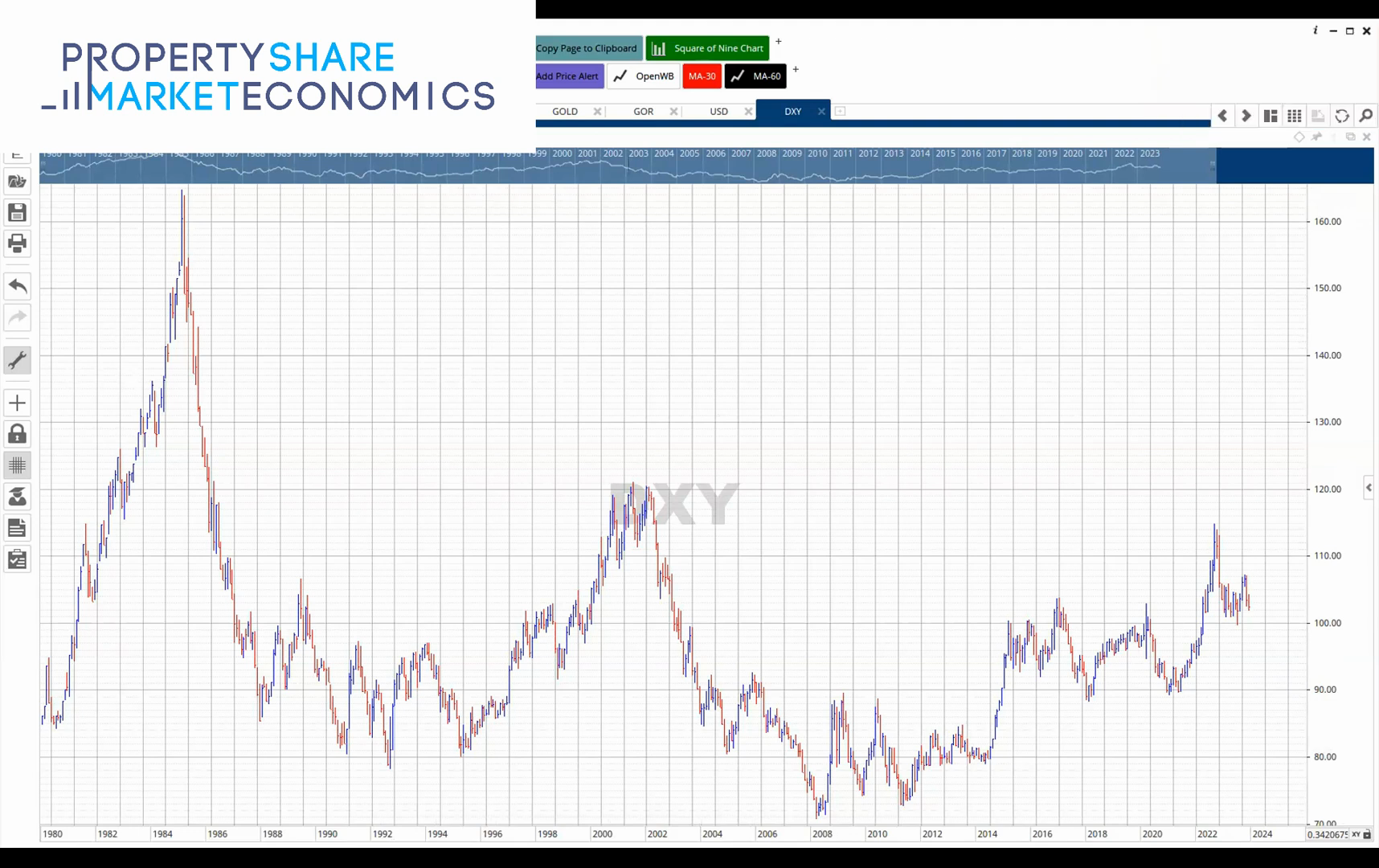 DXY Dollar analysis — technical and fundamental USD analysis from PSE content.
Source: 2023-12-21-bbi-december-2023
DXY Dollar analysis — technical and fundamental USD analysis from PSE content.
Source: 2023-12-21-bbi-december-2023
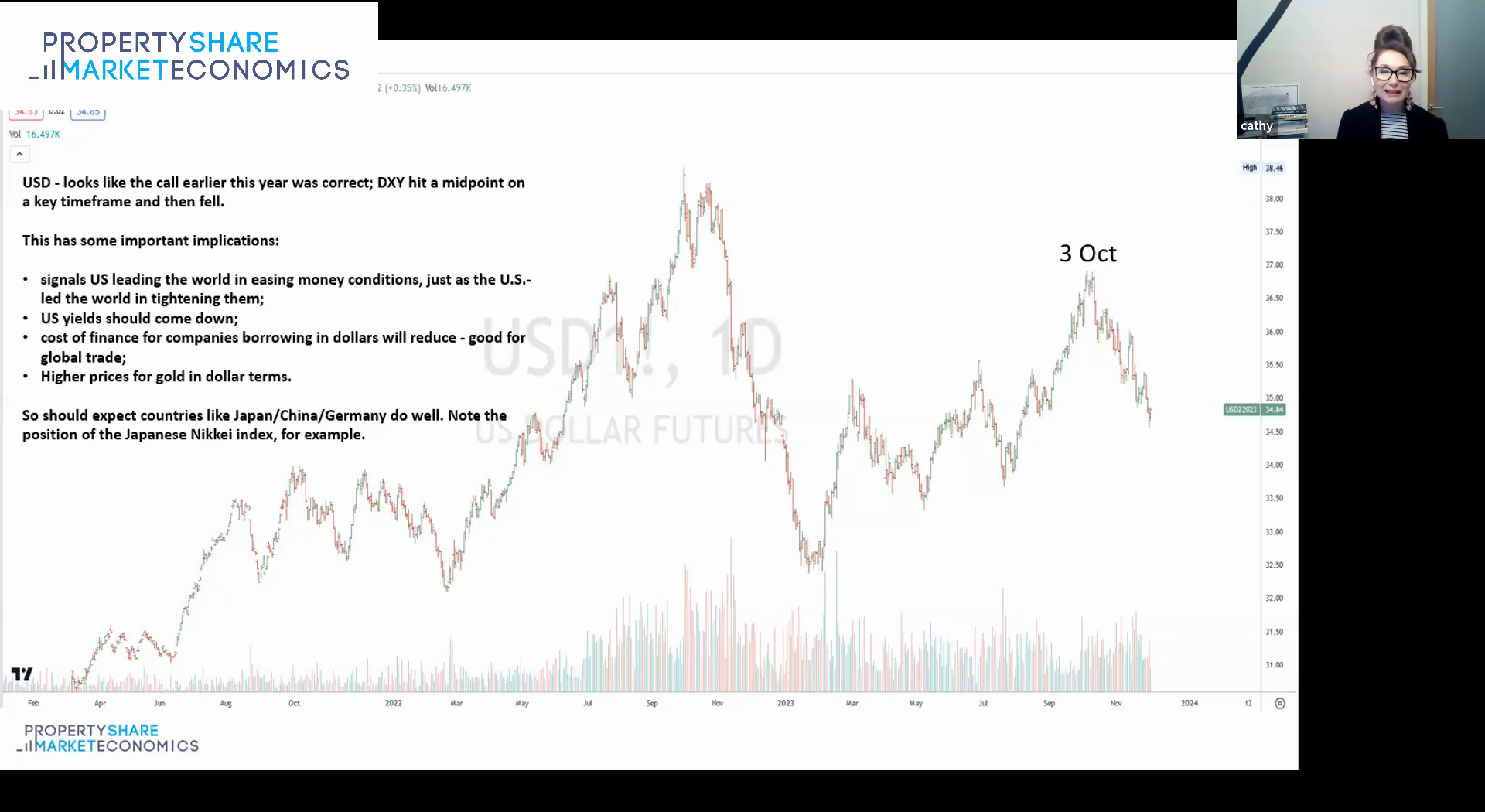 USD futures chart — dollar futures tracking against cycle phases.
Source: 2023-11-03-bbi-november-2023
USD futures chart — dollar futures tracking against cycle phases.
Source: 2023-11-03-bbi-november-2023
 BRICS nations — challenge to dollar hegemony via alternative reserve currency frameworks.
Source: PSE Video
BRICS nations — challenge to dollar hegemony via alternative reserve currency frameworks.
Source: PSE Video
 China vs US GDP — shifting economic balance undermining dollar dominance.
Source: PSE Video
China vs US GDP — shifting economic balance undermining dollar dominance.
Source: PSE Video
 World import/export flows — global trade network underpinning dollar demand.
Source: PSE Video
World import/export flows — global trade network underpinning dollar demand.
Source: PSE Video
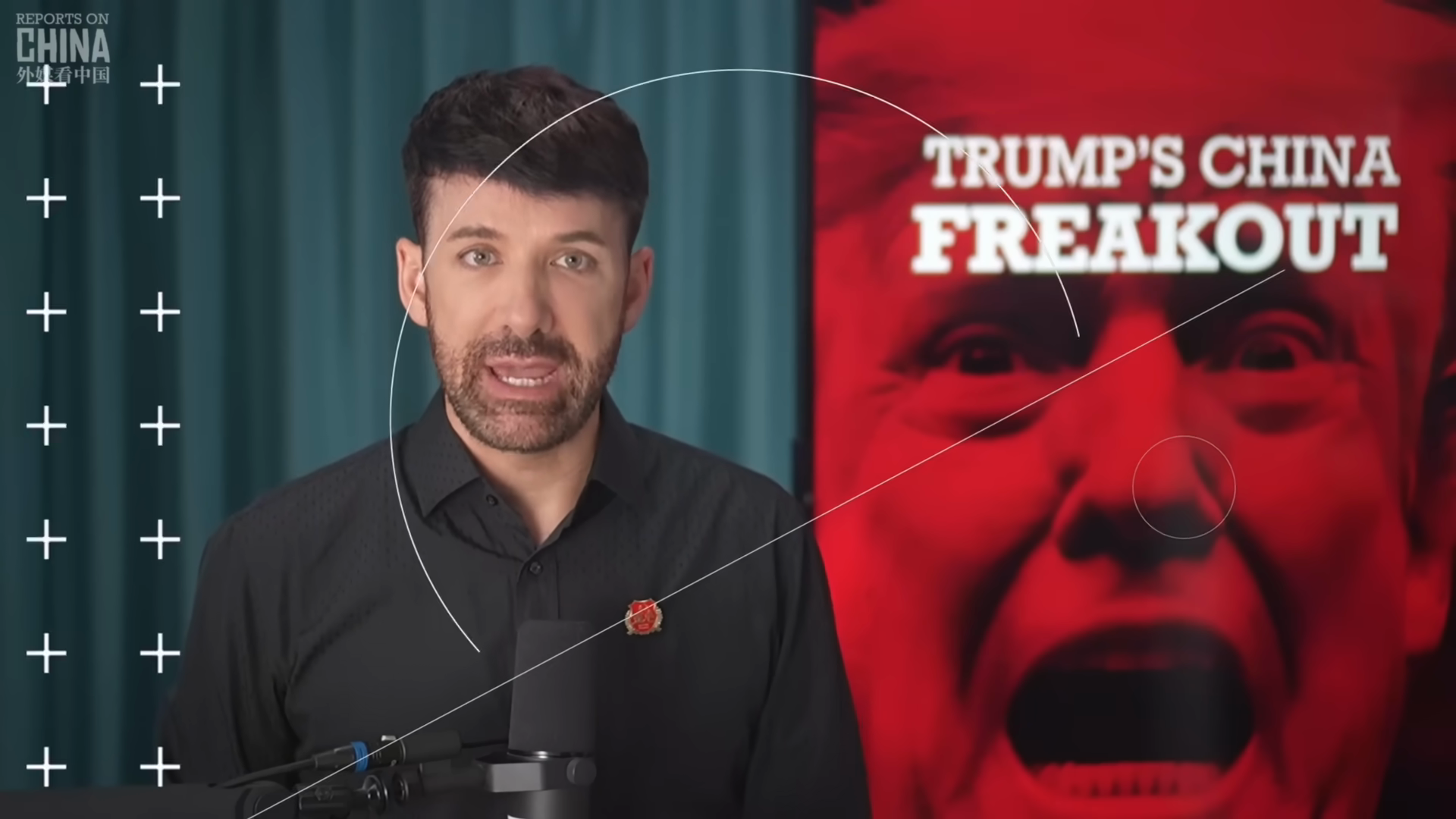 Trade war slide — tariff policy and its implications for dollar hegemony.
Source: PSE Video
Trade war slide — tariff policy and its implications for dollar hegemony.
Source: PSE Video
Additional Sources
-
2026-07-29-bbb-postcard-42-trump-economic-hit-men-redundant (2026-07-29): Phil Anderson argues Trump has made the traditional US “Economic Hit Men” (debt-trap operatives) redundant by directly seizing resources and positioning family in resource/warfare companies. Core thesis: “it’s all about control of the resources. And have those resources traded in USD.” References John Perkins’ Confessions of an Economic Hit Man and the Perkins interview on the Shepheard-Walwyn podcast. [Source: PSE, BBB Postcard 42, 2026-07-29]
-
2026-09-23-gann-33-seasonal-timings (2026-09-23): The US Dollar Index rallying into the September equinox — PSE notes the dollar “will oftentimes see movement during the midpoints as well” of seasonal dates, and that a change in direction lower here “could have implications for other sectors,” notably gold. The equinox reversal-watch is PSE’s nearest-term read on the dollar. — Phil Anderson — confidence: medium [Source: PSE Gann #33, 2026-09-23]