Summary
- 2026-09-22-pse-qa-akhil-patel-part-1 (2026-09-22): PSE’s 30-year commodity cycle forecast has commodities running up into 2027 and then correcting; Patel says be “fairly selective” on commodity exposure during the crisis and recovery phases. He dismisses the popular “commodities are cheap vs the S&P” relative-value chart as an unreliable signal (he was shown it at a Swiss family-office event in 2019 and it has been even more extreme since). Industrial commodities fall in a deep recession unless the US and China stimulate simultaneously as in 2009–11 — “a bit more of a pipe dream” now, with much less fiscal space. — confidence: high [Source: PSE Q&A, Akhil Patel, 2026-09-22] The Commodity Supercycle refers to long-wave (50-60 year Kondratiev wave, or ~30-year Saturn cycle) movements in commodity prices. PSE uses two overlapping frameworks:
-
Kondratiev Long Wave (~55-60 years): Discovered by Russian economist Nikolai Kondratiev studying 19th/20th century Western agricultural prices. Shows 25-30 year upswings and 25-30 year downswings. Peaks typically accompany wars (power struggle for resource trade terms).
-
Saturn 30-Year Cycle: Akhil Patel uses averaged 30-year commodity price segments (Saturn cycle) to generate commodity price forecasts. Track record: forecast April 2011 peak (actual was close), forecast fall to mid-2016 (confirmed), forecast subsequent sideways and then 2020s rise.
Key Historical Data Points (Kondratiev)
| Period | Phase | Driver |
|---|---|---|
| 1790-1815 | Up | Napoleonic Wars (UK peak ~1815) |
| 1815-1845 | Down | Post-war deflation |
| 1845-1866-73 | Up | US Civil War (US peak 1866, UK 1870s) |
| 1873-1900 | Down | Long Depression |
| 1900-1920 | Up | WWI (peak 1920) |
| 1920-1940 | Down | Great Depression |
| 1940-1980 | Up (interrupted) | WWII, Cold War, Vietnam |
| 1980-2000 | Down | Post-Cold War deflation, Asia crisis |
| 2000-2027? | Up | China BRI, US-China resource competition |
PSE Forecast for Current Cycle
- Low in commodity prices: ~2000 (Akhil and Phil)
- 25-27 years from 2000 low → 2025-2027 projected peak
- 30-year Saturn cycle confirmation of same range
- 18.6-year real estate cycle second half (post-2021) is historically bullish for commodities
- All three cycles (30-year, 60-year, 18.6-year real estate) pointing in same direction → very bullish outlook for 2020s commodities
Commodity vs. Stock Market Sequencing
- In every real estate cycle, commodities peak AFTER the stock market (confirmed 1974, 1990, 2008)
- When money exits stocks in 2026, it may flow into commodities → potential final blow-off in commodities 2026-2027
- Gold: tends to surge at end of real estate cycle (banking fears)
Phil Anderson’s End-of-Cycle Sequence (BBI May 27, 2026)
Phil restated his canonical commodity-and-equity peak sequence (referring back to Gann emails #24 and #27 from 2025):
House builders peak first → copper rising → gold → silver → oil → usually the market.
As of late May 2026, the commodity runs are largely played out in direction (though they may drift sideways or modestly higher for another year). The cycle baton has passed to house builders — James Hardie (JHX) is forming an inverse Mexican Pete (see Mex Pete Trading Style); a break of JHX below $17 and a parallel break of the US house-builders index would confirm the Real Estate Cycle Peak is on track.
[Source: BBI Q&A, 2026-05-27]
Cathy Stacey’s Commodity-Timing Reference (Dec 2025 → May 2026 extract)
Cathy’s December 2025 commodity-timing extract (reissued with the May 27 2026 BBI recording email) gives the quantified lag between DJI peak and commodity peak across prior cycles:
| Cycle | Asset | Top relative to DJI |
|---|---|---|
| GFC (2007) | S&P GSCI commodity index | Topped ~8 months AFTER DJI |
| 1989/90 RE-cycle | S&P GSCI commodity index | Topped 63 days AFTER DJI |
| 1987 panic | Gold | Topped 91 days AFTER DJI |
| 1989/90 RE-cycle | Gold | Lower high 63 days AFTER DJI |
| GFC (2007) | Gold | Topped 123 days AFTER DJI |
The K-wave nuance: in the 1970s (final up-phase of the previous K-wave), gold actually peaked before DJI — by Jan 1973 DJI top, gold was already rising back to higher highs. The 2025–26 setup, by contrast, sits in the first decade of the current K-wave up-phase, making the 1987/1990/2007 commodities-AFTER-DJI pattern the better analog than the 1972 inversion. Cathy: “So we have 60 days, 90 days and 120 days. Interesting. But this is just two real estate cycles.”
[Source: BBI Q&A, 2026-05-27; Cathy Stacey, Dec 2025 commodity-timing extract attached to May 27 2026 recording]
Great Wave Context
David Hackett Fischer’s “The Great Wave” (1996) documents ~1000 years of UK commodity prices with alternating centuries of price revolution (up) and flat/falling periods. His thesis: the 20th century’s great price revolution may be followed by near-flat commodity prices through much of the 21st century. PSE acknowledges this as a long-term constraint even while bullish on the 2020s Kondratiev upswing.
Key Features of Kondratiev Upswing
- New countries enter global trade orbit (China WTO 2001 = main driver of 2000s)
- Technology application accelerates (internet technology applied to supply chains, etc.)
- Great powers compete for resource trade terms → geopolitical tension/war
- Political turbulence as old industries decline
- Current dominant “new countries” entering orbit: India, Africa
Key Sources
- 2020-02-28-feb-2020-forecast-class-akhil-commodities — Akhil’s commodity forecast with 30-year and Kondratiev analysis
- 2020-02-28-feb-2020-forecast-class-phil-introduction — Phil’s opening covering Great Wave + Kondratiev
- 2020-02-28-feb-2020-forecast-class-akhil-grand-cycle — Akhil on commodities accompanying second half of real estate cycle
- harrison-interview-part4-2026 — Fred Harrison on commodity cycles and 2026
- 2026-02-19-tim-moffatt-practically-applying-186-cycle — Akhil Patel (Feb 2026): silver ETF Mex Pete breakout became largest Oakleigh fund holding (~100%+ gain); commodity names dominated new-highs lists from late 2024, confirming second-half commodity thesis; gold/silver prioritized due to financial-system health concerns
Current Commodity Breakout Status (July 2026)
GSG (iShares S&P GSCI Commodity-Indexed Trust ETF) broke out from a four-year Mexican Pete basing pattern and retraced ~50% of the move into the $25 breakout level before turning back higher. The retracement low came just after a seasonal date, consistent with Gann timing discipline. [Source: [[2026-07-28-gann-24-commodities-breakout-gsg-dba-drs|Gann #24]], 2026-07-28]
The S&P GSCI / S&P 500 ratio provides the macro framing. Historical spikes in this ratio — when commodities outperform stocks — occurred in 1973, 1990, and 2008, all real estate cycle peaks. Despite the ongoing commodity rally in 2026, the ratio has not yet produced a similar spike. Anderson frames this as suggesting more commodity upside ahead, with the caveat that a sharp equity pullback while commodities hold up could also drive the ratio higher — the classic cycle-peak rotation dynamic. [Source: [[2026-07-28-gann-24-commodities-breakout-gsg-dba-drs|Gann #24]], 2026-07-28]
The current commodity boom is being driven by data centre construction (materials + energy requirements) rather than the China construction boom that drove the 2000s cycle. Anderson notes we could still be in the early stages of the commodity boom, with big implications for interest rates and the end of the real estate cycle’s upswing — an ongoing commodity rally puts pressure on inflation and pushes the Fed toward rate hikes, the mechanism that historically ends the cycle. [Source: [[2026-07-28-gann-24-commodities-breakout-gsg-dba-drs|Gann #24]], 2026-07-28]
Open Questions
- Will the 2020s commodity upswing be muted by the Great Wave (21st century flat prices) or will it still be a significant peak?
- Is gold’s behavior at cycle end (banking crisis = gold spike) consistent with the Kondratiev thesis or an exception?
- Does the Belt and Road Initiative represent an unusually large demand driver that could make the 2020s cycle stronger than average?
- Has the commodity/S&P ratio spike (seen in 1973, 1990, 2008) begun in 2026, or is it still ahead? The absence of a ratio spike despite the commodity rally suggests the final commodity blow-off may not have arrived.
July 2026 Update — Rare Earths as the K-Wave’s Last Bull Market (BBB #61 / Sub #34)
- BBB #61 (Jul 31, 2026): China’s rare-earth export-licensing leverage (66% mined / 88% refined global supply) has triggered Western panic-stockpiling and soaring prices for yttrium, tungsten, antimony, gallium, and germanium — late-K-wave resource nationalism. Darren Wilson’s chart watch list for the cycle’s final bull market: copper, gold, lithium, crude oil, and REMs. Caution flagged: “the cure for high prices is higher prices” — overinvestment plus a potential Chinese supply flood threatens an eventual price crash. [Source: [[sources/2026-07-31-bbb-61-rare-earths-china-kondratieff|BBB #61]], 2026-07-31]
- Sub #34 (Jul 31, 2026): commodities remain last in the peak sequence, “usually as recession has started”; the FOOD ETF (Betashares Global Agriculture, ASX) added as the food-inflation gauge with Gann mid-points marked. [Source: [[sources/2026-07-31-sub-email-34-latest-tracking-re-cycle|PSE Sub #34]], 2026-07-31]
- Gann #09 (May 6, 2026): Uranium identified as a late-cycle commodity — direct parallel to 2006–2008 when uranium prices accelerated into the cycle peak. URA (Global X Uranium ETF) added to US watchlist for breakout above 4.80. DBA (Invesco DB Agriculture Fund) added to portfolio on breakout above 28 (pyramid half position). DBC removed from US watchlist but broad commodity theme still monitored. [Source: [[sources/2026-05-06-gann-09-market-update-to-5-may|Gann #09]], 2026-05-06]
Visual Evidence
Slides from PSE content showing commodity supercycles, price trends, and the 30-year commodity cycle.
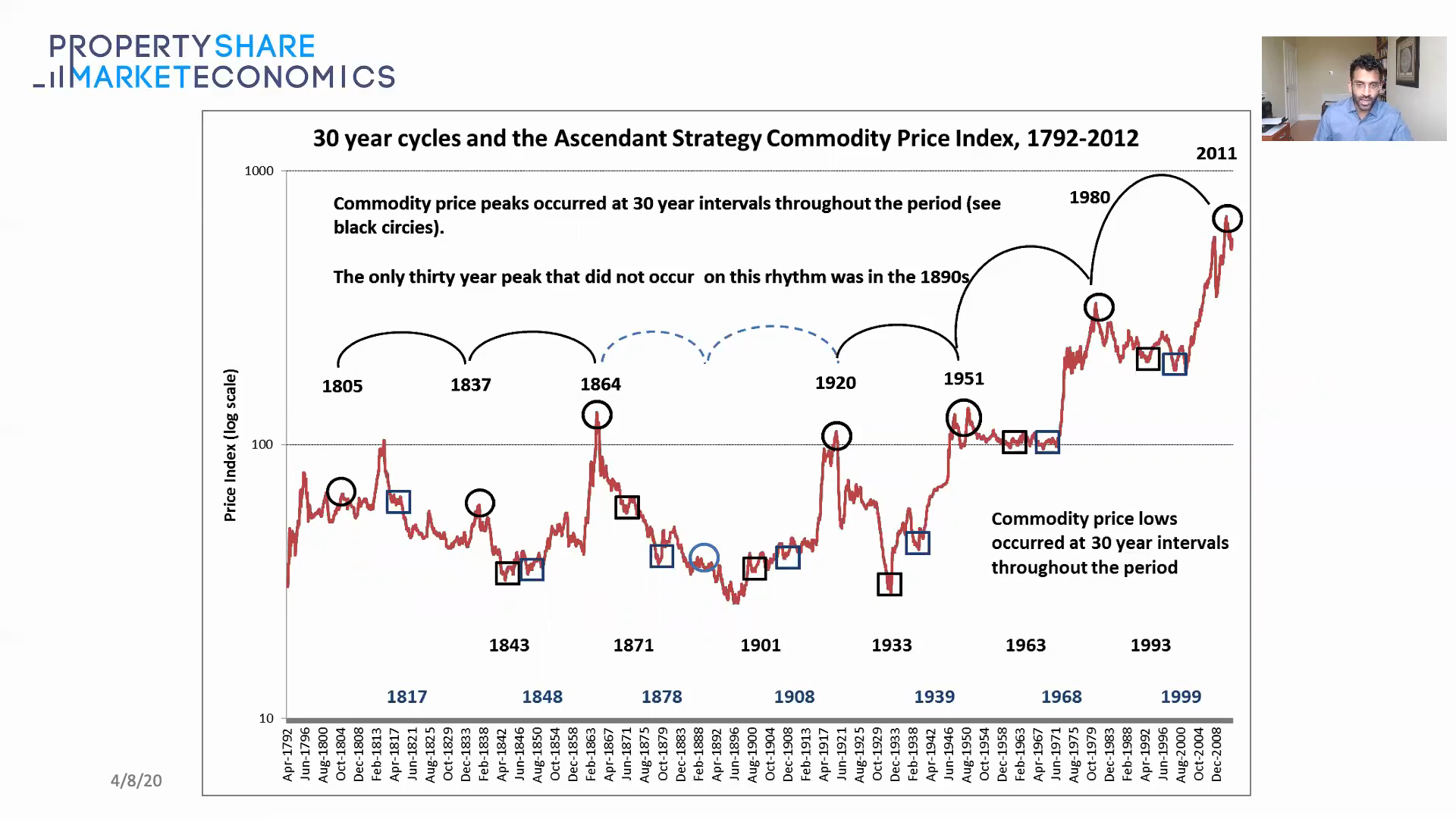 Commodity price trends — 30-year cycles — historical commodity cycle chart.
Source: PSE Video
Commodity price trends — 30-year cycles — historical commodity cycle chart.
Source: PSE Video
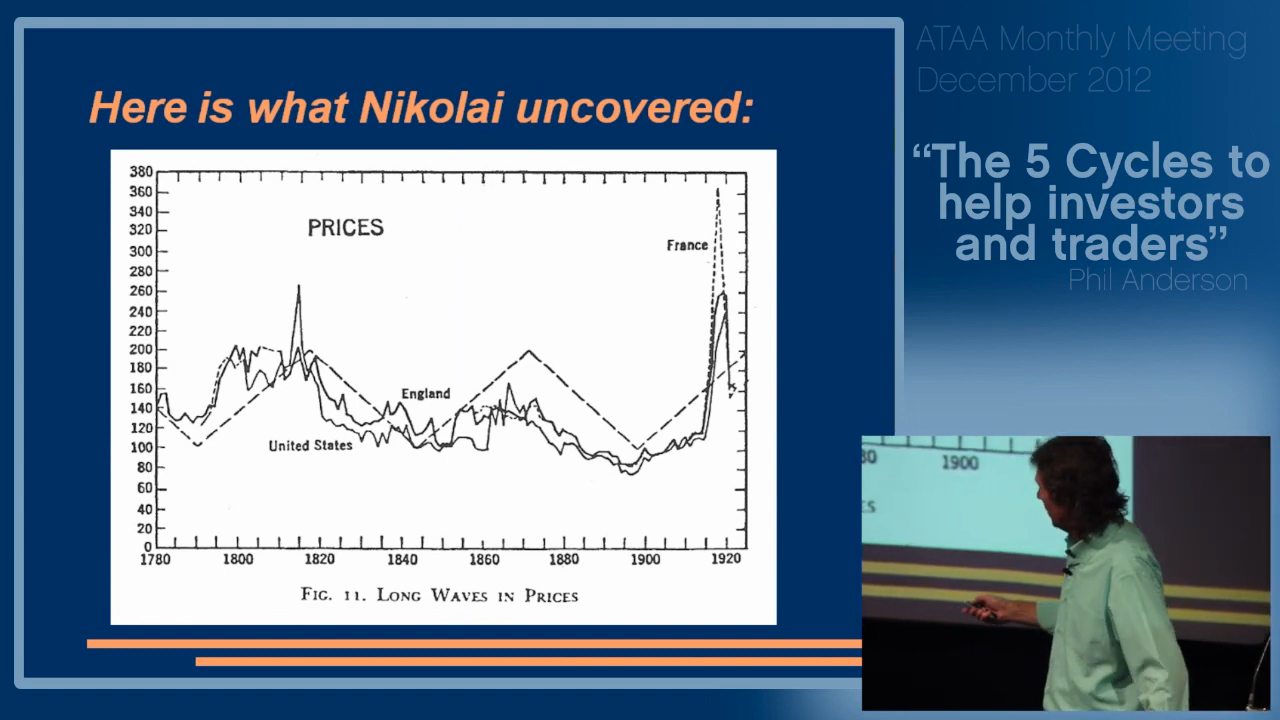 Commodity price cycles — Kondratieff wave overlaid with commodity price history.
Source: PSE Video
Commodity price cycles — Kondratieff wave overlaid with commodity price history.
Source: PSE Video
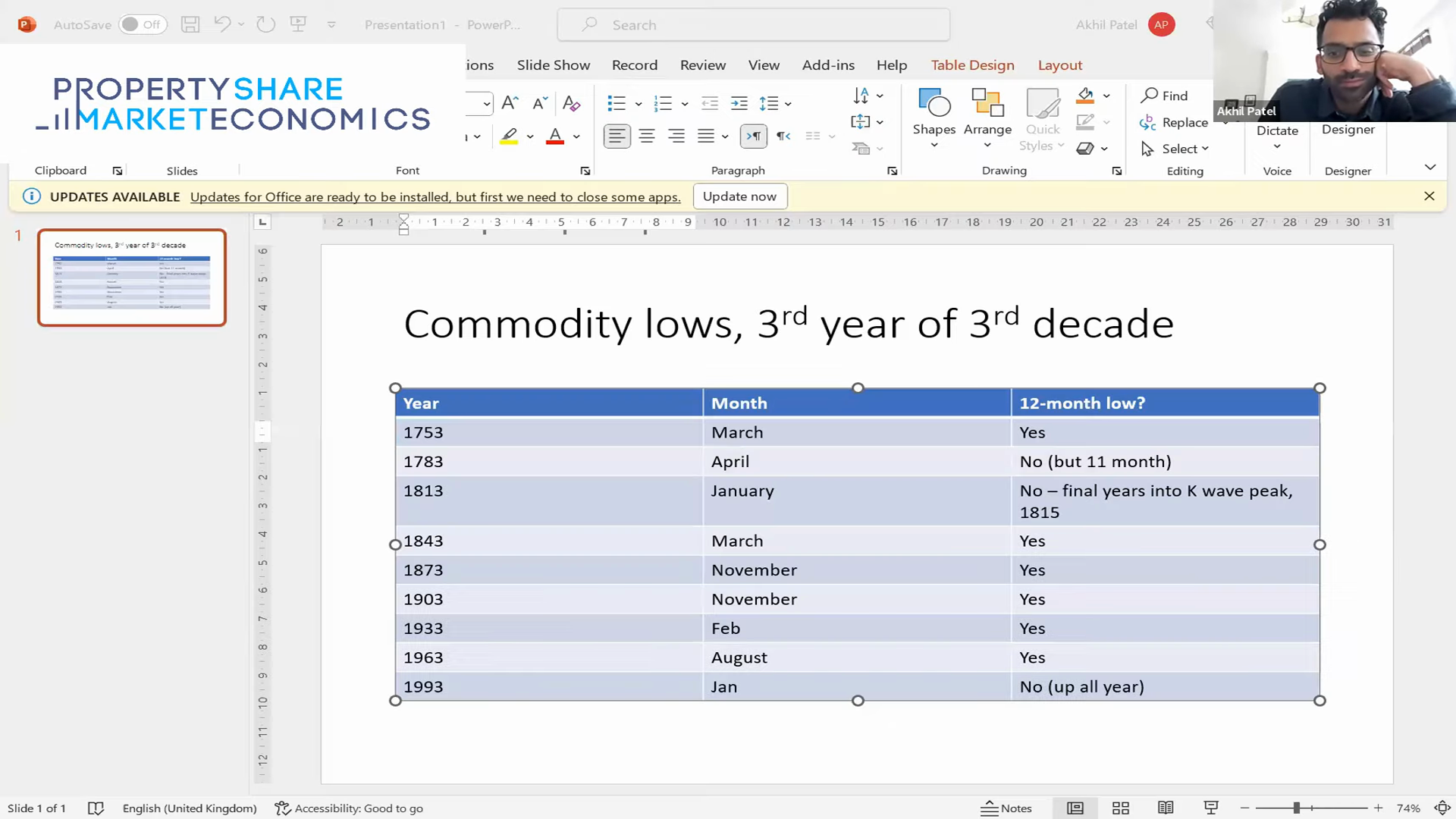 Commodity lows in 3rd years — table showing commodity cycle patterns by decade.
Source: PSE Video
Commodity lows in 3rd years — table showing commodity cycle patterns by decade.
Source: PSE Video
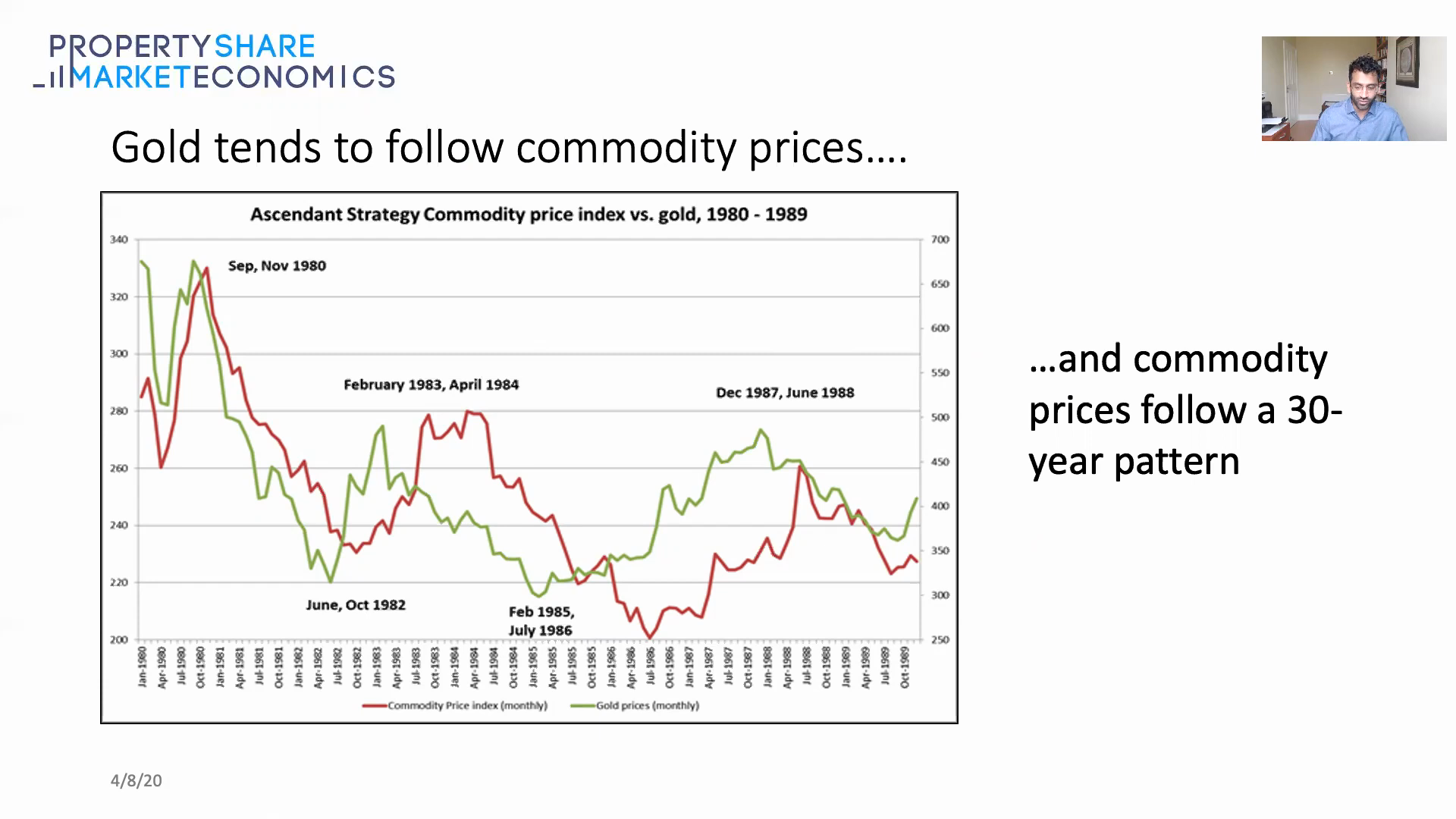 Commodity/Gold price index — long-term chart from historical series.
Source: PSE Video
Commodity/Gold price index — long-term chart from historical series.
Source: PSE Video
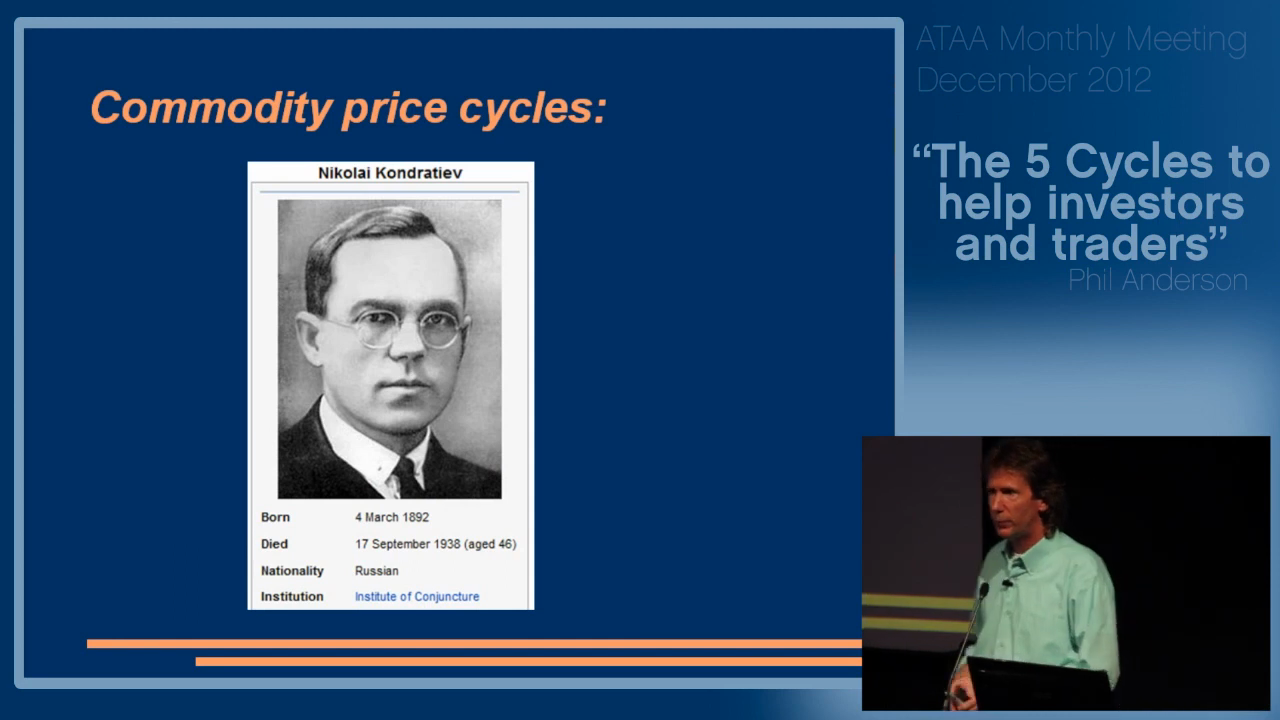 Nikolai Kondratiev and commodity prices — the K-wave and commodity supercycle connection.
Source: PSE Video
Nikolai Kondratiev and commodity prices — the K-wave and commodity supercycle connection.
Source: PSE Video
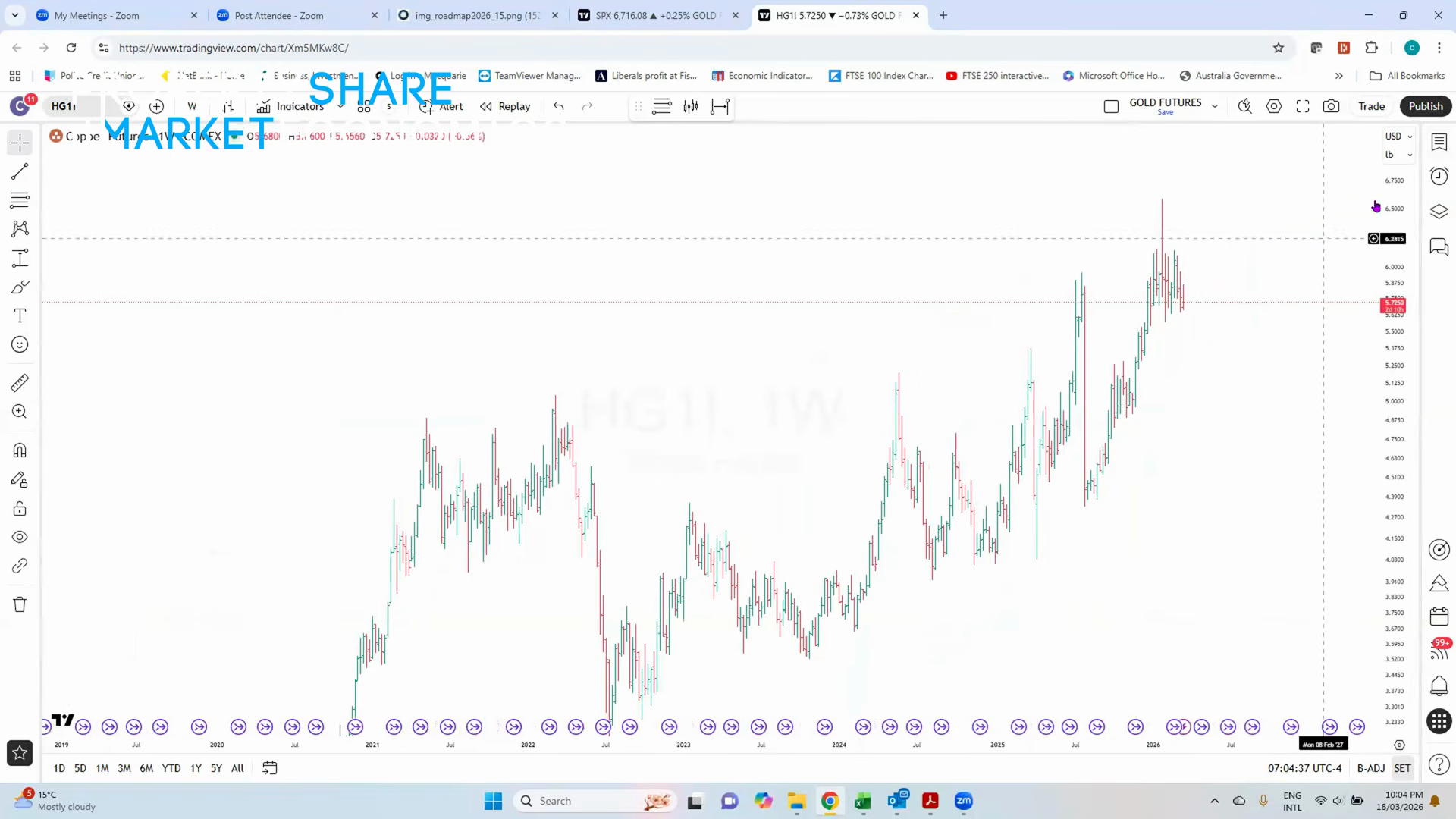 Copper futures price chart — industrial metal as commodity cycle indicator.
Source: PSE Video
Copper futures price chart — industrial metal as commodity cycle indicator.
Source: PSE Video
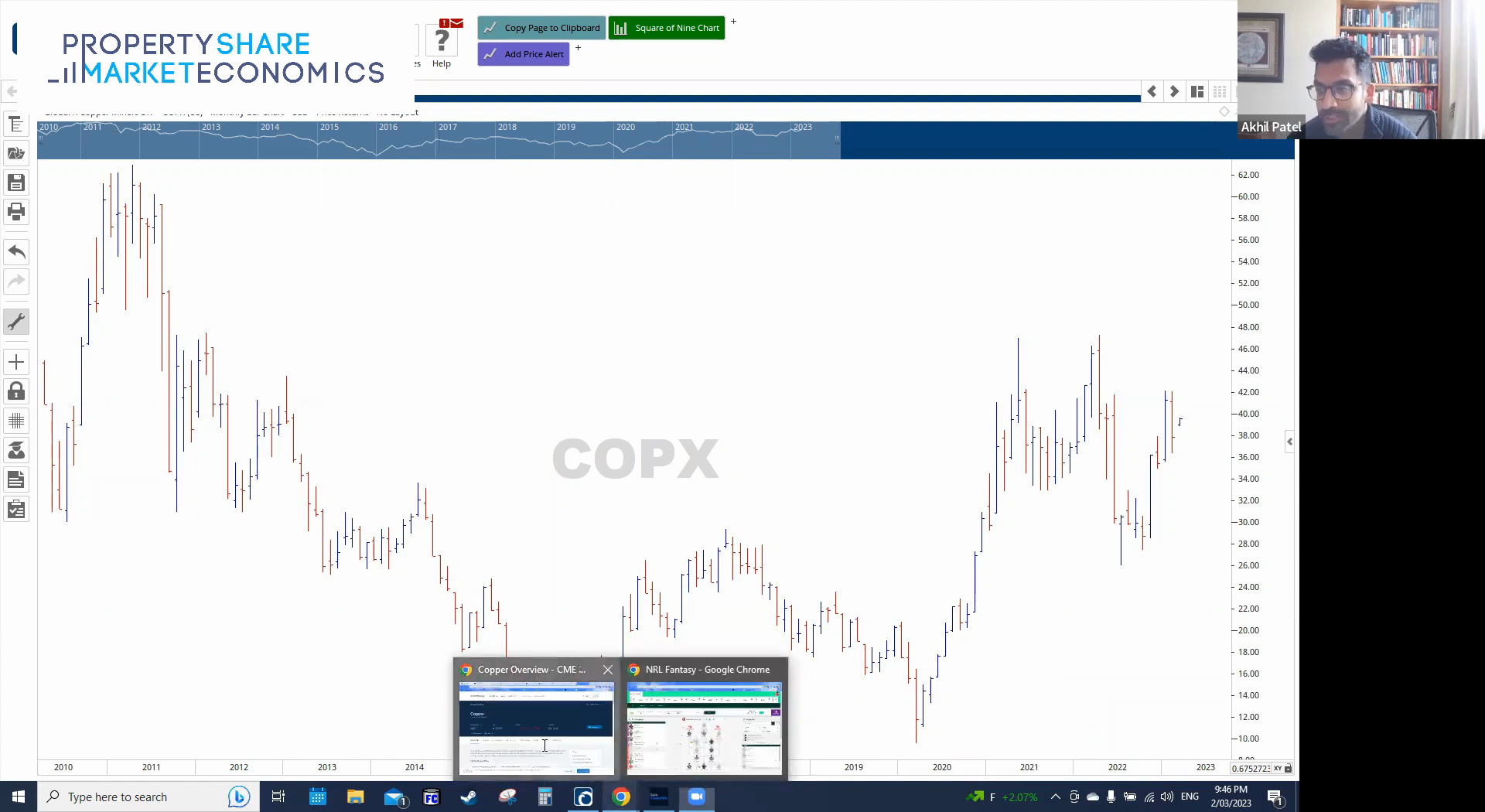 Copper futures analysis — PSE commentary on copper as a leading commodity indicator.
Source: 2023-02-02-bbi-february-2023
Copper futures analysis — PSE commentary on copper as a leading commodity indicator.
Source: 2023-02-02-bbi-february-2023
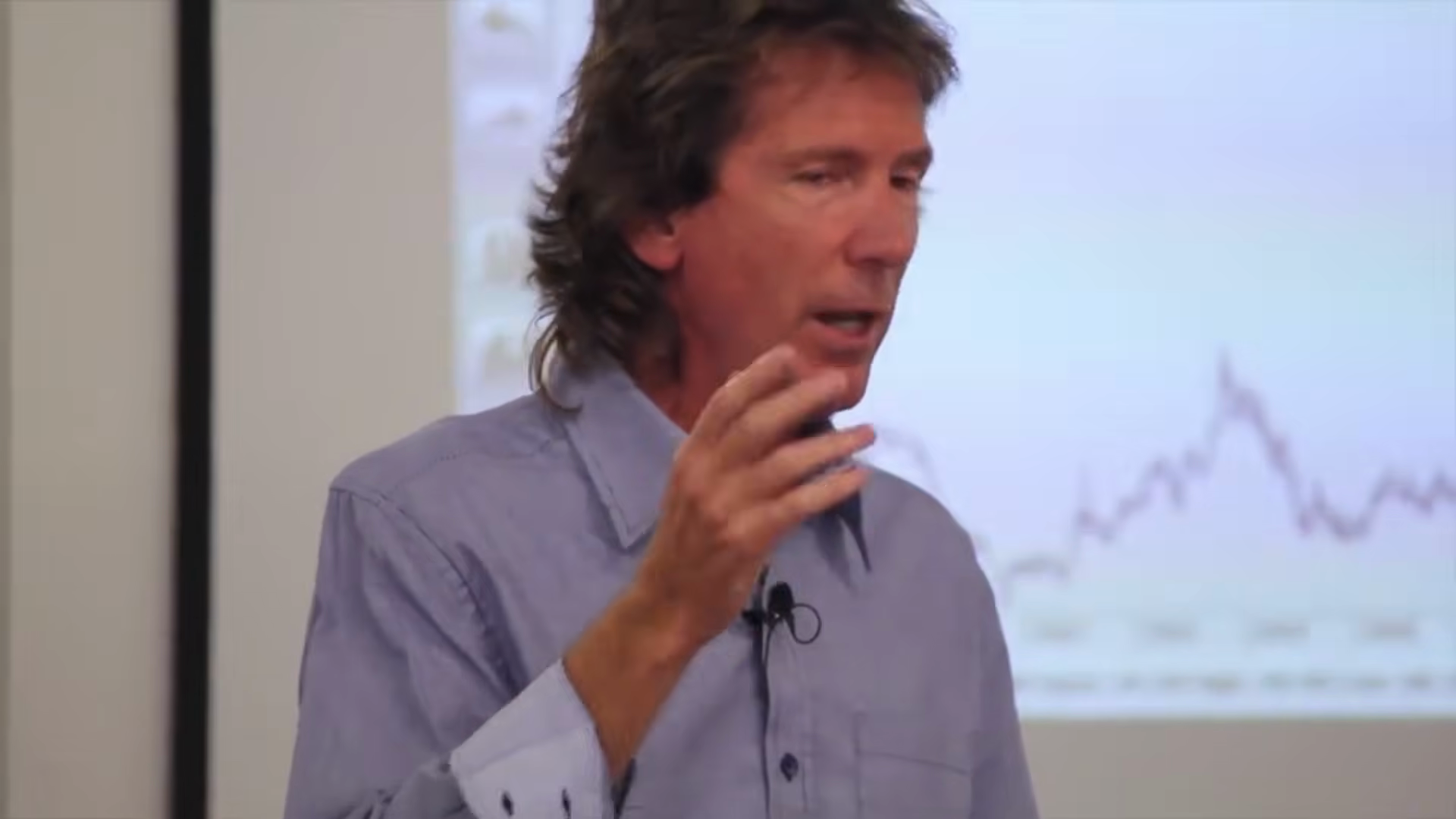 Cotton futures — historical chart used in Gann/PSE commodity analysis.
Source: PSE Video
Cotton futures — historical chart used in Gann/PSE commodity analysis.
Source: PSE Video
- 2026-09-23-gann-33-seasonal-timings (2026-09-23): Gold mining equities are outperforming the metal — “the mining stocks have held up much better than the precious metal itself.” VanEck Gold Miners (GDX) retraced the late-July rally back to its 200-day moving average with the 50-day close to crossing back above; a dollar reversal lower at the equinox would be a tailwind. GDX time counts: most recent high 30 days ago, late-July low 60 days ago. — Phil Anderson — confidence: medium [Source: PSE Gann #33, 2026-09-23]